2026-07-30 中国科学院(CAS)
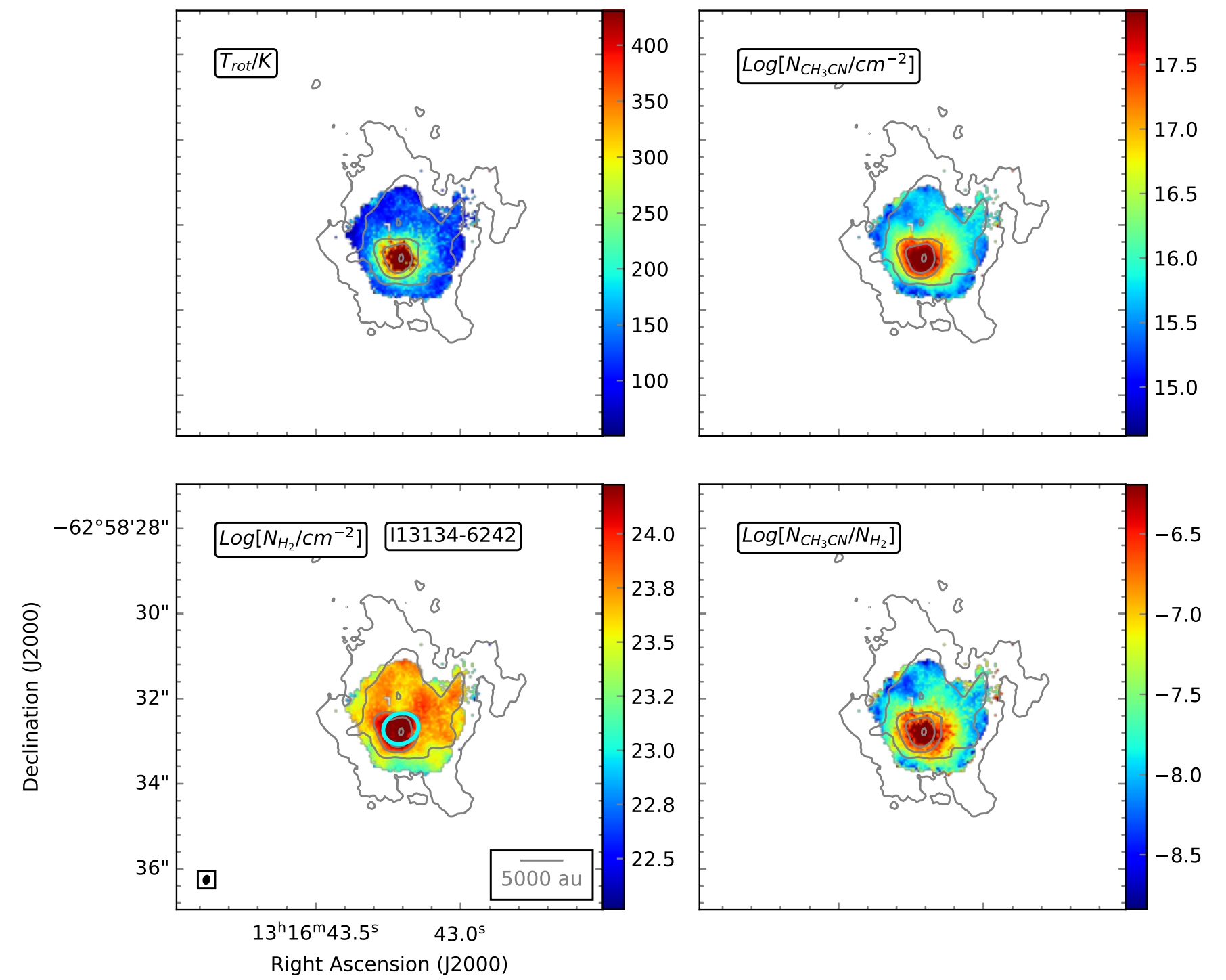
An example of temperature, density and abundance distributions. (Image by XAO)
<関連情報>
- https://english.cas.cn/newsroom/research-news/202607/t20260731_1186759.shtml
- https://iopscience.iop.org/article/10.3847/1538-4365/ae77e7
ALMA-QUARKSサーベイ:高温分子核における大質量原始星の熱フィードバックの調査 The ALMA-QUARKS Survey: Investigating Thermal Feedback of Massive Protostars in Hot Molecular Cores
Dezhao Meng, Tie Liu, Jarken Esimbek, Yisheng Qiu, Jixing Ge, Neal J. Evans II, Aina Palau, Guido Garay, Paul F. Goldsmith, Fengwei Xu
The Astrophysical Journal Published: 2026 July 8
DOI:10.3847/1538-4365/ae77e7
Abstract
We identify a sample of 83 spatially resolved hot molecular cores (HMCs) in the Querying Underlying mechanisms of massive star formation with ALMA-Resolved gas Kinematics and Structures (QUARKS) survey, aiming at investigating thermal feedback from massive stars. Using CH3CN (12–11) line emission together with 1.3 mm continuum data, we derive the radial temperature, volume density, and CH3CN abundance profiles for the 83 HMCs. Based on the envelope temperature and density profiles, we compute the luminosities of the embedded massive protostars with the RADMC-3D radiation transfer model. The derived luminosities are comparable (within ∼1 dex) to the bolometric luminosities of their natal clumps and show strong correlations with several core-scale properties, including the HMC mass (Log[Menv] = 1.01 Log[L⋆] − 4.80), the inner core radius (the flat radius of Plummer-like volume density profile) (Log[a] = 0.46 Log[L⋆] + 0.52), and the central density (Log[nc] = −0.55Log[L⋆] + 10.47). These empirical relations provide useful observational constraints for physical models of protostellar objects. Importantly, we find a strong positive correlation between the massive protostellar luminosity and the local thermal Jeans mass. The derived Jeans masses, MJeans, exceed the HMC masses Menv, with the average MJeans being two times larger than the average Menv. This provides observational evidence that thermal feedback from massive protostars can effectively suppress further fragmentation of HMCs, thereby promoting massive star formation. In addition, the positive correlation between massive protostellar luminosity and natal clump mass suggests that more massive clumps preferentially host more luminous protostars, leading to stronger thermal feedback.