2026-07-03 量子科学技術研究機構,東京大学
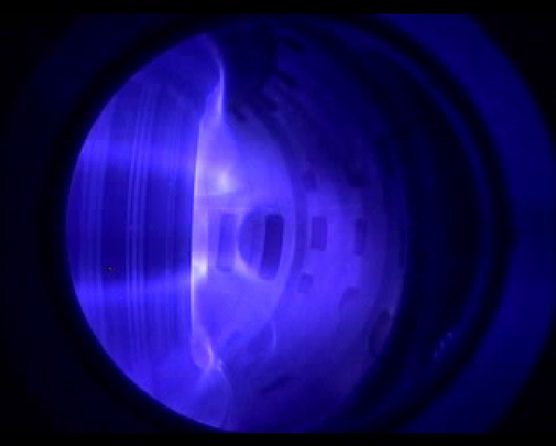
図1.JT-60SAの初プラズマ
<関連情報>
- https://www.qst.go.jp/site/press/20260703.html
- https://iopscience.iop.org/article/10.1088/1741-4326/ae78e6
JT-60SAにおける低誘導電界プラズマ起動法の開発 Development of low inductive electric field plasma start-up in JT-60SA
T. Wakatsuki, H. Urano, M. Yoshida, N. Tsujii, Hyun-Tae Kim, T. Nakano, M. Fukumoto, Y. Ohtani, R. Sano, S. Inoue,…
Nuclear Fusion Published 3 July 2026
DOI:10.1088/1741-4326/ae78e6
Abstract
Plasma start-up experiments have been performed in JT-60SA under ITER-relevant low inductive electric field conditions. A systematic investigation was conducted to identify the key factors that determined the success or failure of start-up. Ohmic field null configuration (FNC) start-up experiments were found to be strongly limited by high impurity content. In EC-assisted FNC, start-up was hindered by sensitivity to device model uncertainties (e.g. discrepancies between the as-modeled CS/EF coil geometry and the effective coil positions during operation), which induced residual poloidal magnetic fields and outward plasma shifts, reducing the effectiveness of EC heating during burn-through. In contrast to FNC, the trapped particle configuration (TPC) applied a finite vertical magnetic field from the breakdown phase, enabling robust plasma position control and effective utilization of EC heating even when the breakdown timing and the early-phase poloidal field evolution are uncertain. This robustness led to the achievement of the JT-60SA first plasma. Notably, line-integrated spectroscopic diagnostics showed that, although individual differences existed between failed FNC and successful TPC discharges during the breakdown phase, the failed FNC discharges were not systematically characterized by lower breakdown-phase density or electron-temperature indicators. This indicates that, under the present EC-assisted conditions, the start-up outcome was not determined solely by the breakdown-phase plasma parameters, but was strongly affected by the subsequent impurity burn-through phase. Additional experiments demonstrated that TPC also enhanced EC-assisted breakdown, particularly for X2 heating, and enabled successful X2-only start-up. The lower power threshold for X2 start-up was found to be approximately 0.7 MW, set by the requirement for impurity burn-through rather than breakdown itself. These results demonstrate that TPC enables reliable plasma start-up under ITER- and DEMO-relevant conditions through the combined effects of robust position control and efficient EC heating.