2026-06-25 ウースター工科大学(WPI)
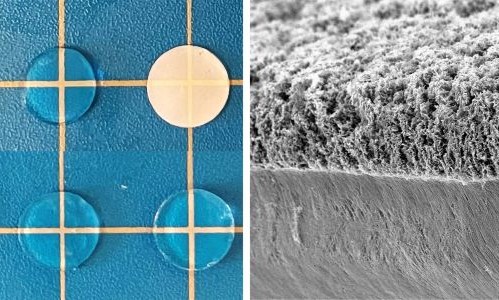
At left, hydrogels developed by Jiawei Yang and a team of researchers exhibit different colors according to their coatings. At right, a microscopic image of a hydrogel surface. Photos courtesy of Jiawei Yang.
<関連情報>
- https://www.wpi.edu/news/researchers-develop-system-customize-hydrogel-implants
- https://www.science.org/doi/10.1126/sciadv.aee3894
生体接着性、線維化、および硬さを個別に制御できるモジュール式ハイドロゲルシステム A modular hydrogel system with independent control of bioadhesion, fibrosis, and stiffness
Jiawei Yang, Yichao Zhao, William J. Jeang, Steffen Pabel, […] , and Daniel G. Anderson
Science Advances Published:24 Jun 2026
DOI:https://doi.org/10.1126/sciadv.aee3894
Abstract
Hydrogels that adhere to biological tissues and resist fibrosis are required to provide both optimal functionality and appropriate stiffness on diverse soft tissues to achieve therapeutic efficacy and biocompatibility. However, their performance is often limited by an intrinsic trade-off between functionality and stiffness. Through the incorporation of polymer brush coatings, we develop a modular hydrogel system to enable independent control of functionality and stiffness. By tailoring coating chemistry, coating thickness, and hydrogel network topology, we obtain consistent bioadhesion (~100 joules per square meter) and fibrosis suppression across the full stiffness range of soft tissues (1 kilopascal to 1 megapascal). Using this approach, we design a hydrogel that can maintain stable adhesion in vivo on a beating mouse heart and a hydrogel with no fibrotic capsule in immunocompetent mice over 40 days. This modular system offers a customizable approach for designing functional implants with tailored mechanical properties.