2026-06-18 東京科学大学
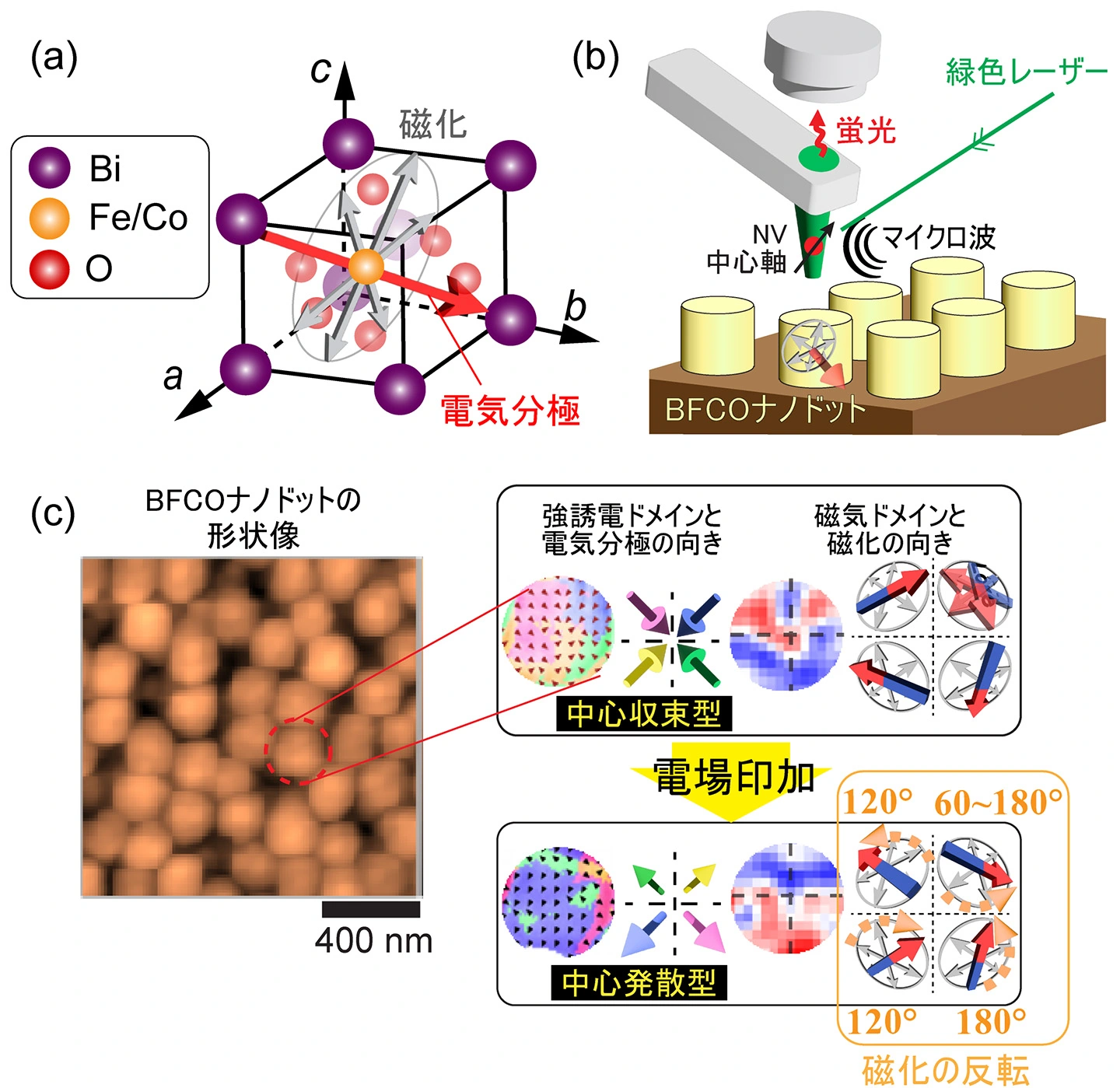
図. (a)BFCOの結晶構造と電気分極・磁化の方向。これまでの研究から、BFCOの磁化は、図の灰色の円に示すように、電気分極と直交した6方向のいずれかの方向を向くことが分かっている。
(b)ダイヤモンドNV中心をプローブに用いたBFCOナノドットの観察の模式図。
(c)原子間力顕微鏡により取得したBFCOナノドットの形状像。
<関連情報>
Co置換BiFeO₃ナノドットにおける強誘電トポロジカルドメインスイッチングによる電場誘起強磁性ドメイン変化 Electric field–induced ferromagnetic domain change by ferroelectric topological domain switching in Co-substituted BiFeO3 nanodots
Koomok Lee, Peter Meisenheimer, Paul Stevenson, Yasuhito Nagase, […] , and Masaki Azuma
Science Advances Published:17 Jun 2026
DOI:https://doi.org/10.1126/sciadv.aec2861
Abstract
Electric field–induced magnetization reversal accompanying polarization switching is promising for low–power consumption, nonvolatile, voltage-write, magnetic-read memory applications. Perovskite BiFe0.9Co0.1O3 is a room-temperature multiferroic material in which both ferroelectric and weakly ferromagnetic orders coexist, with spontaneous magnetization coupled to the ferroelectric polarization. Here, we report electric field–induced ferroelectric and ferromagnetic domain changes in BiFe0.9Co0.1O3 nanodots using a combination of piezoresponse microscopy and scanning nitrogen-vacancy center magnetometry assisted by image analysis techniques to directly observe both ferroic orders on the nanometer scale. The complex ferroelectric domains present in a 190-nanometer structure which can be switched from a net-down to a net-up polarization by scanning with a biased cantilever, accompanied by reversal of both in-plane and out-of-plane components of the magnetization. This directly demonstrates electric field–induced magnetization reversal accompanying 180° polarization switching in a complex structure of a scale relevant to the semiconductor industry, creating a potential path for next generation memory devices.