2026-06-17 東京大学
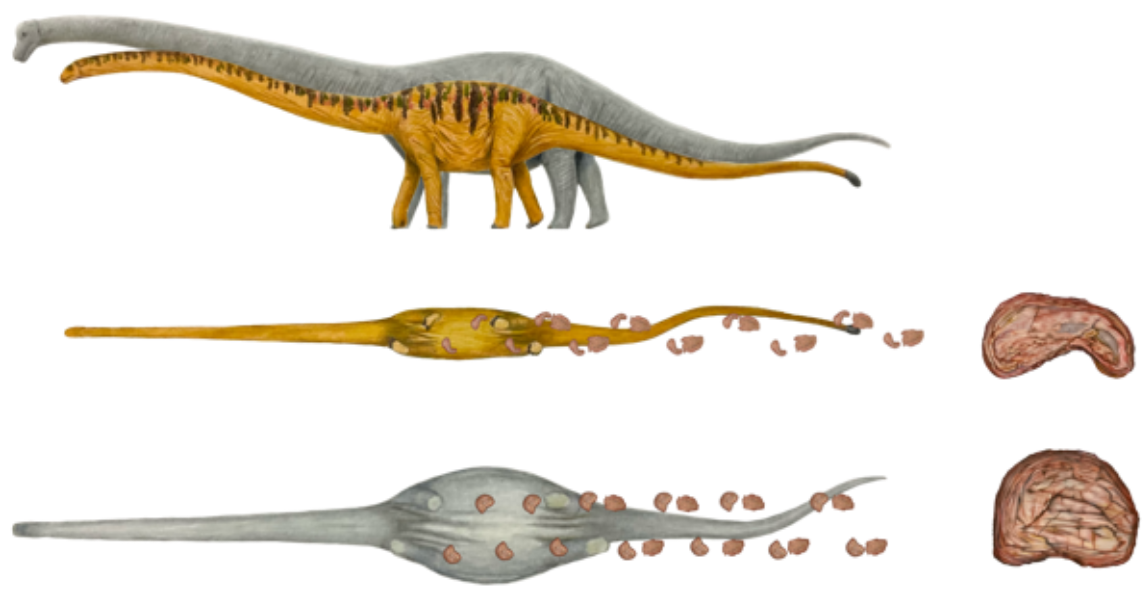
研究成果のまとめ。白亜紀にかけて、前足の形態がより円形に変化している。 (©︎宇津城遥平)
<関連情報>
- https://www.k.u-tokyo.ac.jp/information/category/press/0030137.html
- https://www.cambridge.org/core/journals/paleobiology/article/temporal-changes-in-sauropodomorph-foot-morphology-and-graviportal-adaptations-under-gigantism-inferred-from-trackways/003FE59B8D8E2792E49190A7EAF3B61D?utm_campaign=shareaholic&utm_medium=copy_link&utm_source=bookmark
巨大化に伴う竜脚形類の足の形態と重力ポータル適応の時間的変化を足跡から推測する Temporal changes in sauropodomorph foot morphology and graviportal adaptations under gigantism inferred from trackways
Kohei Yamaguchi,Tai Kubo and,Mugino O. Kubo
Paleobiology Published:15 June 2026
DOI:https://doi.org/10.1017/pab.2026.10098
Abstract
Sauropodomorphs were the largest terrestrial animals to have ever existed on Earth.
While previous studies using skeletal remains and digital 3D models suggested that manus became more circular shape and relatively larger over time, this study uses trackways to test these hypotheses with a much larger sample size. In this study, we used the sauropodomorph trackway record from the Early Jurassic to the Late Cretaceous to analyze temporal changes in manus and pes shapes and their relationship with body size. We analyzed footprint measurements from 690 trackways and, for the first time, applied elliptic Fourier descriptors (EFDs) to sauropodomorph footprint outlines to quantitatively assess their morphology. Analyses revealed temporal and size-related changes in manus morphology, whereas no changes were observed in pedes. Specifically, manus shape became anteroposteriorly longer over time and in larger individuals. The relative manus area compared with pes area (the heteropody) also increased chronologically; however, manus areas showed negative allometry relative to pes areas. These results indicate that the temporal change toward circular or horseshoe-shaped manus morphology in sauropodomorphs represents an adaptation to gigantism, while the chronological increase in manus size relative to the pes reflects the radiation of a clade (Titanosauria) with proportionally large manus.