
2026-06-11 東京科学大学
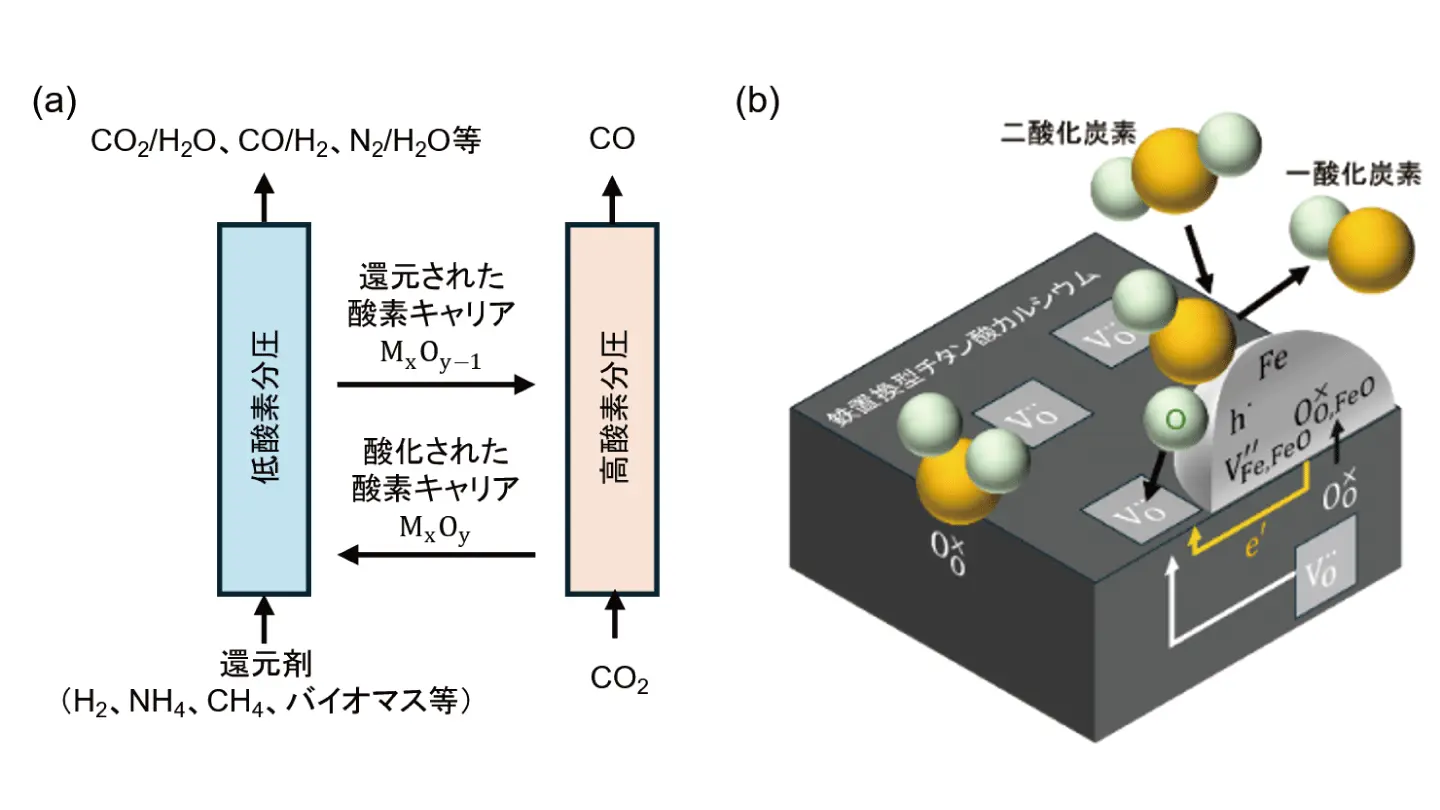
図1. (a)ケミカルルーピングCO2還元システムの概念図と(b)鉄置換チタン酸カルシウム(CTFO)によるCO2還元反応加速機構のイメージ図
<関連情報>
- https://www.isct.ac.jp/ja/news/eadaplen4fuq#top
- https://www.sciencedirect.com/science/article/abs/pii/S1385894726039161
混合イオン伝導体と電子伝導体を用いた化学ループ式CO2分解における金属酸化物酸化還元反応の協調的促進 Cooperative enhancement of the metal oxide redox reaction in chemical looping CO2 splitting using a mixed ionic and electronic conductor
Takayuki Kosaka, Arufa Shiota, Junichiro Otomo
Chemical Engineering Journal Available online: 20 April 2026
DOI:https://doi.org/10.1016/j.cej.2026.176455
Highlights
- Fe-doped CaTiO3 was investigated as a support of Fe in chemical looping.
- Fe oxidation by CO2 was enhanced with Fe-doped CaTiO3.
- 100% CO selectivity was confirmed by a fluidized bed reactor.
- The enhancement is attributed to mixed ionic and electronic conductivity.
- Concentration of electron and oxygen vacancy may be related to the rate constants.
Abstract
Chemical looping CO2 splitting reduces CO2 to CO in an oxidation reaction coupled with a subsequent reduction reaction of metal oxides. This study demonstrated that calcium titanate (CaTiO3), a non-rare earth perovskite that exhibits mixed ionic and electronic conductivity on substitution of Ti by Fe, substantially enhances CO2 splitting. Fe-doped CaTiO3 exhibits high electronic conductivity (10–1.2 S cm−1 at 900 °C) and ionic conductivity (10–1.8 S cm−1 at 900 °C) at the oxygen partial pressure at which CO2 splitting by Fe oxidation occurs (pO2 = 10−17–10−16 atm). Kinetic analysis showed that Fe-doped CaTiO3 enhances CO2 splitting more effectively than a pure oxide ion conductor or an insulator. This is attributed to the cooperative effects of metal oxidation and the high ionic and electronic conductivities of the support at pO2 = 10−17–10−16 atm, as well as oxide ion and electron conduction at the metal–support interface. The increase in the concentration of electron as well as oxygen vacancy on the substitution of Ti in CaTiO3 by Fe likely contributes to the increase in the kinetic constant of CO2 splitting. These findings provide insights into the design of support materials and metal redox reactions.

