2026-07-27 横浜国立大学
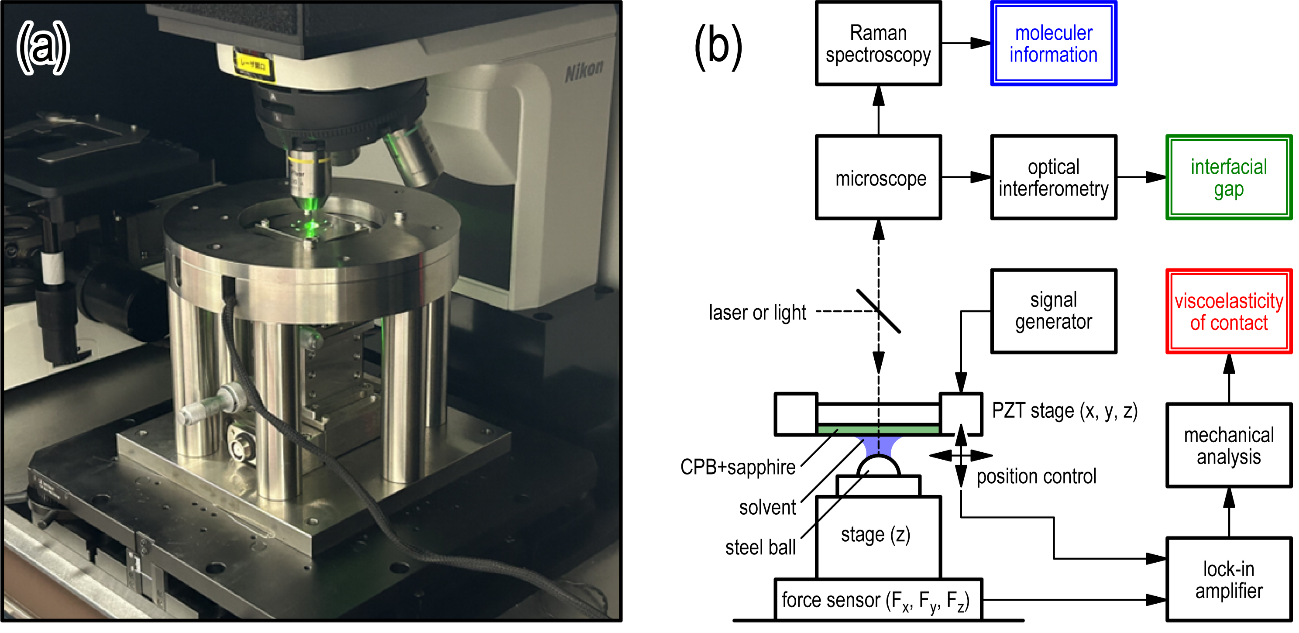
図2 本研究で開発した同時計測技術の(a)外観図と(b)概要図
<関連情報>
- https://www.ynu.ac.jp/hus/koho/018943/detail.html
- https://pubs.acs.org/aamick/article/doi/10.1021/acsami.6c11287/5233697/Multimodal-Operando-Characterization-of-Layering
濃縮ポリマーブラシ界面における層状構造と摩耗のマルチモーダルオペランド特性評価 Multimodal Operando Characterization of Layering and Wear at Concentrated Polymer Brush Interfaces
Hikaru Okubo;Daiki Kagiwata;Toru Takeuchi;Ken Nakano;Yoshinobu Tsujii
ACS Applied Material & Interfaces Published:July 27, 2026
DOI:https://doi.org/10.1021/acsami.6c11287
Abstract
A multimodal operando measurement system integrating a surface force apparatus, optical interferometry, and Raman spectroscopy was developed to investigate layering, molecular-state evolution, and wear at concentrated polymer brush (CPB) interfaces in a good solvent. The system enables simultaneous monitoring of mechanical responses, interfacial gap, and molecular behavior at solid–liquid interfaces under both compression and sliding. Operando measurements during compression revealed that CPBs exhibit a hierarchical layered structure consisting of dilute, semidilute, middle, and concentrated layers, each characterized by distinct transition gaps in mechanical responses (Fz, ϕz) and molecular concentration profiles. Raman spectroscopic analysis further showed that the CPB-derived full width at half-maximum, ΓCPB, exhibits a nonmonotonic dependence on applied load. This behavior is interpreted as a Raman-detectable signature of compression-induced molecular-state changes in the confined CPB layer, reflecting changes in molecular mobility and local structural heterogeneity. The transition from a highly swollen, relatively mobile state to a deswollen, more constrained molecular state was closely associated with the onset and acceleration of CPB wear. Layer-resolved wear analysis, achieved by alternately performing contact and friction tests, demonstrated that CPB wear proceeds via a random chain-scission mode, in which the dilute layer is continuously regenerated while the concentrated layer gradually diminishes. Multimodal operando measurements during sliding revealed that this random scission is associated with localized tensile-strain-like deformation imposed on polymer chains under frictional shear in the glassy-like confined state. These results establish a unified operando framework linking hierarchical layering, compression-induced molecular-state changes, and wear mechanisms at polymer brush interfaces and provide design principles for achieving durable, superlow-friction polymer brush lubrication systems.