2026-05-12 韓国基礎科学研究院(IBS)
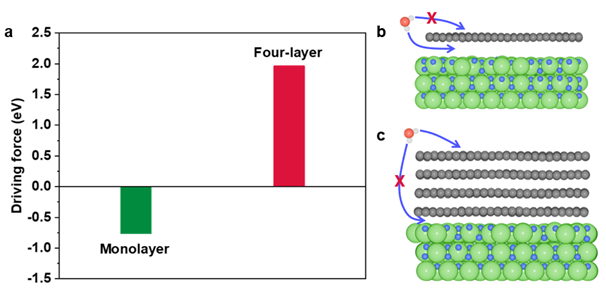
Figure 1. a) This bar chart shows the “energy cost” for a single water molecule to sneak underneath graphene.
<関連情報>
- https://www.ibs.re.kr/cop/bbs/BBSMSTR_000000000738/selectBoardArticle.do?nttId=26682&pageIndex=1&searchCnd=&searchWrd=
- https://www.nature.com/articles/s41467-026-71053-3
機械学習を用いたシミュレーションでは、グラフェンは疎水性であり、微視的に濡れない透明であると予測される Machine-learning enhanced simulations predict graphene is hydrophobic and microscopically not wetting transparent
Dianwei Hou,Yevhen Horbatenko,Stefan Ringe & Minhaeng Cho
Nature Communications Published:02 April 2026
DOI:https://doi.org/10.1038/s41467-026-71053-3 Unedited version
Abstract
The interaction between graphene and water is fundamental to applications ranging from filtration to nano-electronics, yet the intrinsic wettability of graphene remains a subject of longstanding debate. In particular, it is disputed whether graphene is wetting transparent—transmitting the wettability of an underlying substrate to the surface. Here, we show using machine-learning enhanced molecular dynamics simulations that pristine graphene is intrinsically hydrophobic and microscopically not wetting transparent. By simulating vibrational sum-frequency generation spectra, we demonstrate that the apparent hydrophilic signatures often observed for monolayer graphene on hydrophilic substrates originate not from wetting transparency, but from signal cancellation caused by water molecules intercalated between the graphene and the substrate. Furthermore, we find that while water intercalation is thermodynamically favorable for monolayers, it becomes unfavorable for multilayer graphene, explaining experimentally observed thickness-dependent wetting behaviors. These findings provide a unified microscopic framework for understanding graphene-water interactions and clarify the crucial role of confined water in two-dimensional material interfaces.