2026-05-07 東北大学
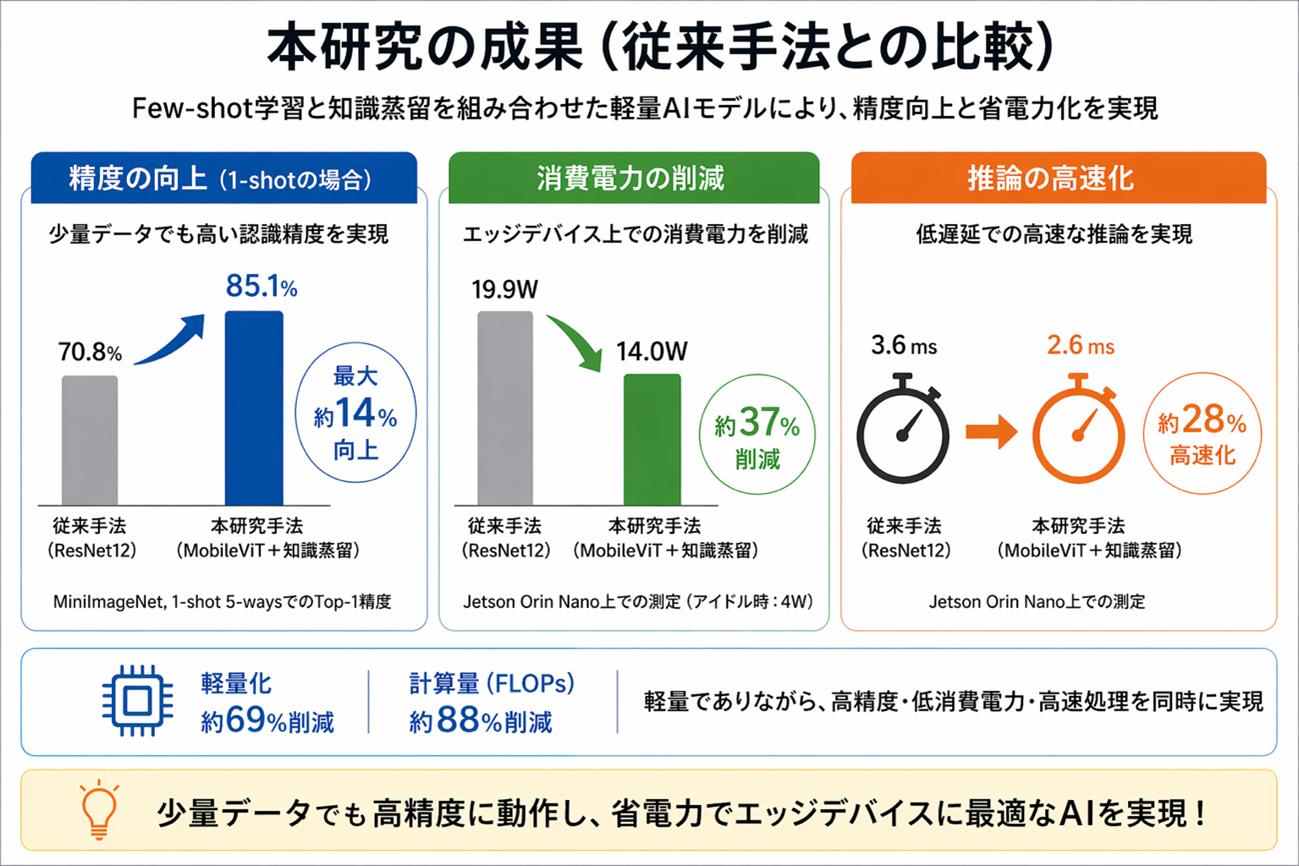
図1. 従来AIと本研究手法の比較 従来は大量データと高い計算資源を必要としたのに対し、本研究では少量データで学習可能かつ省電力で動作するエッジAIを実現。
<関連情報>
- https://www.tohoku.ac.jp/japanese/2026/05/press20260507-01web-fewshot.html
- https://arxiv.org/abs/2603.26145
- https://ieeexplore.ieee.org/document/11462745
MobileViTにおける知識蒸留によるエッジAI向け効率的な少数ショット学習 Efficient Few-Shot Learning for Edge AI via Knowledge Distillation on MobileViT
Shuhei Tsuyuki, Reda Bensaid, Jérémy Morlier, Mathieu Léonardon, Naoya Onizawa, Vincent Gripon, Takahiro Hanyu
arXiv Submitted on 27 Mar 2026
DOI:https://doi.org/10.48550/arXiv.2603.26145
ICASSP 2026 – 2026 IEEE International Conference on Acoustics, Speech and Signal Processing Date Added to IEEE Xplore:21 April 2026
DOI:https://doi.org/10.1109/ICASSP55912.2026.11462745
Abstract
Efficient and adaptable deep learning models are an important area of deep learning research, driven by the need for highly efficient models on edge devices. Few-shot learning enables the use of deep learning models in low-data regimes, a capability that is highly sought after in real-world applications where collecting large annotated datasets is costly or impractical. This challenge is particularly relevant in edge scenarios, where connectivity may be limited, low-latency responses are required, or energy consumption constraints are critical. We propose and evaluate a pre-training method for the MobileViT backbone designed for edge computing. Specifically, we employ knowledge distillation, which transfers the generalization ability of a large-scale teacher model to a lightweight student model. This method achieves accuracy improvements of 14% and 6.7% for one-shot and five-shot classification, respectively, on the MiniImageNet benchmark, compared to the ResNet12 baseline, while reducing by 69% the number of parameters and by 88% the computational complexity of the model, in FLOPs. Furthermore, we deployed the proposed models on a Jetson Orin Nano platform and measured power consumption directly at the power supply, showing that the dynamic energy consumption is reduced by 37% with a latency of 2.6 ms. These results demonstrate that the proposed method is a promising and practical solution for deploying few-shot learning models on edge AI hardware.