
2026-05-19 ハーバード大学
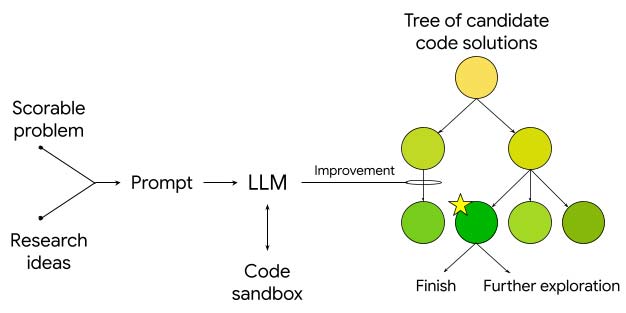
Schematic of the algorithm that feeds a scorable task and research ideas to an LLM, which generates evaluation code in a sandbox. This code is then used in a tree search, where new nodes are created and iteratively improved using the LLM. Credit: Google
<関連情報>
- https://seas.harvard.edu/news/ai-system-automates-coding-scientific-research
- https://www.nature.com/articles/s41586-026-10658-6
科学者が専門家レベルの実証的ソフトウェアを作成するのを支援するAIシステム An AI system to help scientists write expert-level empirical software
Eser Aygün,Anastasiya Belyaeva,Gheorghe Comanici,Marc Coram,Hao Cui,Jake Garrison,Renee Johnston,Anton Kast,Cory Y. McLean,Peter Norgaard,Zahra Shamsi,David Smalling,James Thompson,Subhashini Venugopalan,Brian P. Williams,Chujun He,Sarah Martinson,Martyna Plomecka,Lai Wei,Yuchen Zhou,Qian-Ze Zhu,Matthew Abraham,Erica Brand,Anna Bulanova,… Michael P. Brenner
Nature Published:19 May 2026
DOI:https://doi.org/10.1038/s41586-026-10658-6 Unedited version
Abstract
The cycle of scientific discovery is frequently bottlenecked by the slow, manual creation of software to support computational experiments1. To address this, we present Empirical Research Assistance (ERA), an AI system that creates expert-level scientific software whose goal is to maximize a quality metric. The system uses a Large Language Model (LLM) and Tree Search (TS)2 to systematically improve the quality metric and intelligently navigate the large space of possible solutions. ERA achieves expert-level results when it explores and integrates complex research ideas from external sources. The effectiveness of tree search is demonstrated across a diverse range of tasks. In bioinformatics, ERA discovered 40 novel methods for single-cell data analysis that outperformed the top human-developed methods on a public leaderboard. In epidemiology, ERA generated 14 models that outperformed the CDC ensemble and all other individual models for forecasting COVID-19 hospitalizations. ERA also produced expert-level software for geospatial analysis, neural activity prediction in zebrafish, and numerical solution of integrals, and a novel rule-based construction for time series forecasting. By devising and implementing novel solutions to diverse tasks, ERA represents a significant step towards accelerating scientific progress.

