2026-05-09 合肥物質科学研究院(HFIPS)
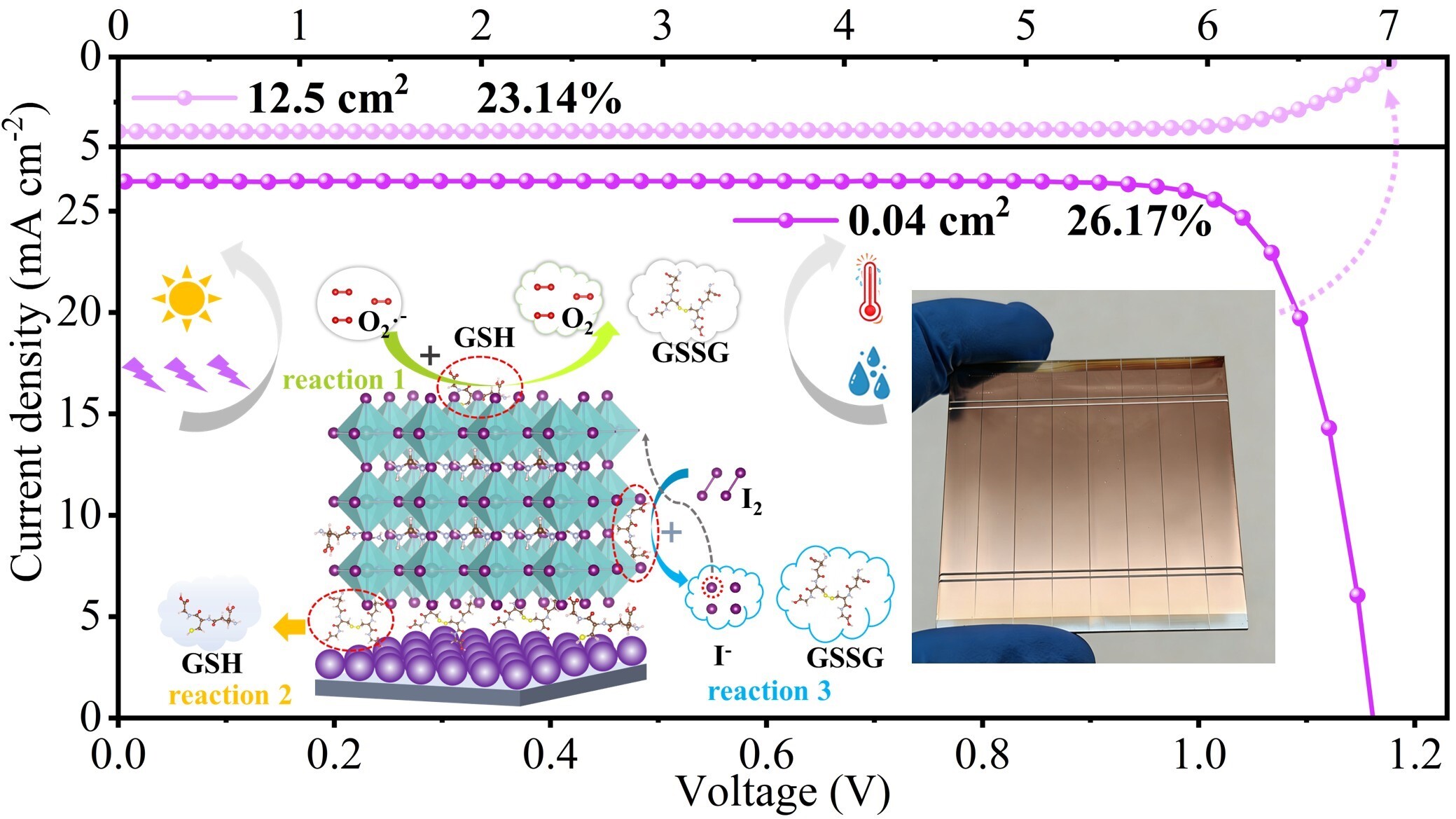
Schematic diagram of the power conversion efficiency of small-area solar cells and mini-modules, as well as the redox-driven self-healing mechanism. (Image by JIN Mengqi)
<関連情報>
- https://english.hf.cas.cn/nr/rn/202605/t20260509_1158643.html
- https://advanced.onlinelibrary.wiley.com/doi/10.1002/adma.73036
多機能性グルタチオンが、双極子エンジニアリングと酸化還元駆動型自己修復により、ISOS耐性のある逆型ペロブスカイト太陽電池を実現する Multifunctional Glutathione Enables ISOS-Robust Inverted Perovskite Solar Cells via Dipole Engineering and Redox-Driven Self-Healing
Mengqi Jin, Dong Yang, Hu Shen, Shiying Tang, Lili Liu, Yang Wang, Chaofan Zheng, Jiajin Kuang, Chaoyang Wang, Faisal Naveed, Chong Chen
Advanced Materials Published: 11 April 2026
DOI:https://doi.org/10.1002/adma.73036
ABSTRACT
Self-assembled monolayer (SAM)-based inverted perovskite solar cells (PSCs) suffer from a persistent efficiency-stability trade-off issue, which limits their commercialization. Herein, we propose a synergistic stabilizing strategy using reduced glutathione (GSH) as a multifunctional additive, integrating dipole modulation and redox-driven self-healing. GSH enables cross-scale regulation: inducing interfacial dipole via a concentration gradient, passivating bulk defects through Pb2+ coordination, optimizing crystallization kinetics, providing chemical protection against O2•− and moisture, and establishing a GSH/oxidized glutathione (GSSG)-Ni2+/Ni3+ redox cycle for self-healing at the NiOx/SAM interface. Moreover, the interaction between GSSG and NiOx opens an additional hole transport channel, effectively suppressing device performance degradation induced by ultraviolet (UV) irradiation and thermally-triggered cleavage of hydroxy groups in the SAM. Benefiting from the aforementioned advantages endowed by GSH, the small-area cell (4 mm2) achieved a high efficiency of 26.17%, while the 12.50 cm2 minimodule reached 23.14%—among the highest values reported for modules with comparable active areas. Target devices also exhibit exceptional ISOS (International Summit on Organic Photovoltaic Stability) protocols stability: retaining 69.8% (ISOS-T-1, 200 h), 91.0% (ISOS-D-1, 1056 h), and 78.44% (ISOS-L-2, 336 h) of their initial efficiency. This work breaks the efficiency-stability trade-off and offers a “dynamic regulation-static protection” design principle for PSCs.