2026-04-20 ブラウン大学
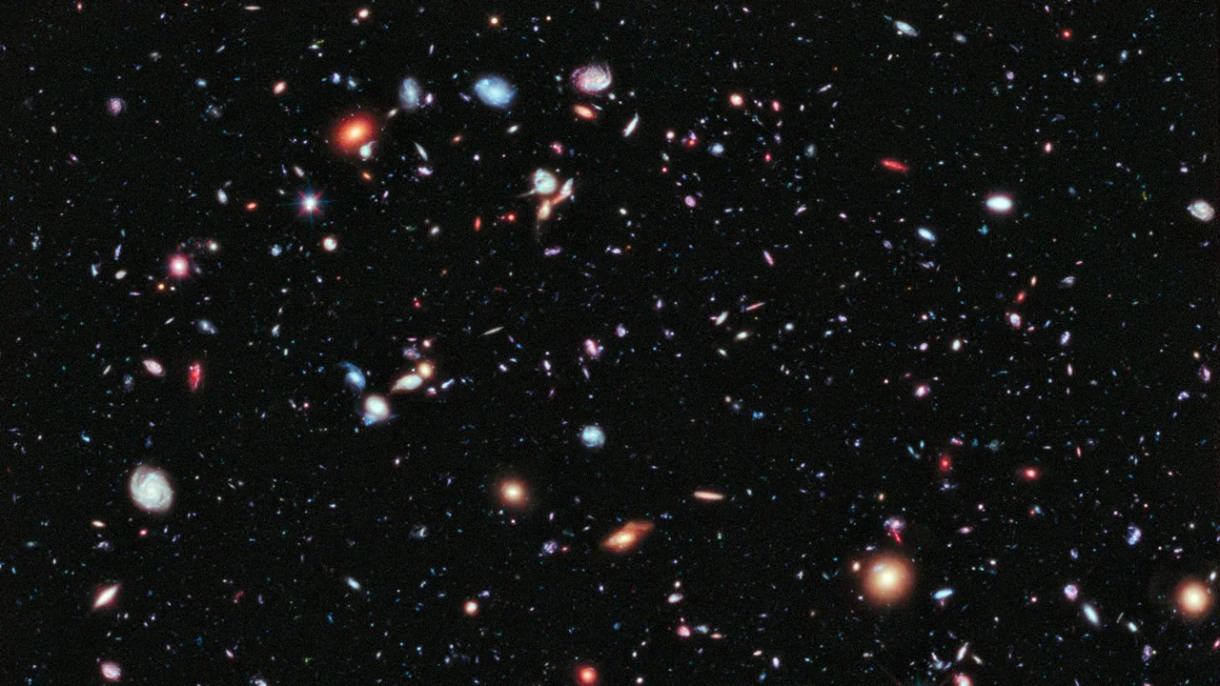 The Hubble Space Telescope showed that distant galaxies are moving away from Earth faster than those nearby, a sign that the universe’s expansion is increasing at rate described by the cosmological constant. That value of that constant is one of the great mysteries of modern physics. Credit: NASA.
<関連情報>
- https://www.brown.edu/news/2026-04-20/cosmological-constant-problem
- https://journals.aps.org/prl/abstract/10.1103/rzz5-p4f4
量子重力理論による宇宙定数真空と重力ホール効果 Cosmological Constant from Quantum Gravitational Vacua and the Gravitational Hall Effect
Stephon Alexander, Heliudson Bernardo, and Aaron Hui
Physical Review Letters Published: 17 April, 2026
DOI: https://doi.org/10.1103/rzz5-p4f4
Abstract
We provide a new perspective on the cosmological constant by exploring the background-independent Wheeler-DeWitt quantization of general relativity. The Chern-Simons-Kodama state of quantum gravity, a generalization of the Hartle-Hawking and Vilenkin states, has a striking structural similarity to the topological field theory of the quantum Hall effect. As a result, we study the gravitational topological θ sectors in analogy to Yang-Mills theory. We find that the cosmological constant Λ is intimately linked to the θ parameter by θ=122/(Λℓ2Pl) mod 2 due to the fact that Chern-Simons-Kodama state must live in a particular θ sector. This result is shown in the canonical, nonperturbative formalism. Furthermore, we explain how the physics of the Hamiltonian constraint is analogous to the quantum Hall effect, with the cosmological constant playing the role of a quantum gravitational Hall resistivity. These relations suggest that Λ is topologically protected against perturbative graviton loop corrections, analogous to the robustness of quantized Hall conductance against disorder in a metal.