2026-04-15 中国科学院(CAS)
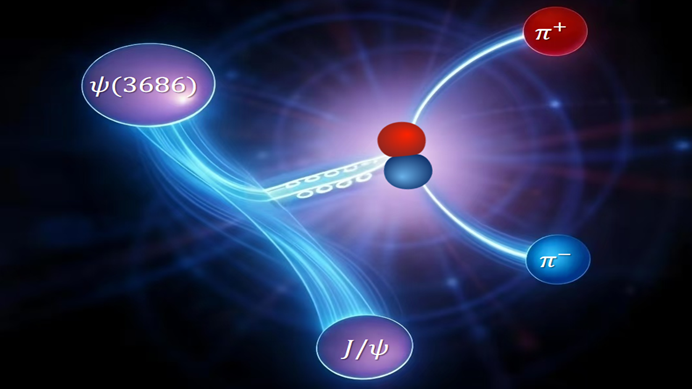
Schematic diagram of the decay ψ(3686) → π⁺π⁻ J/ψ (Image by IHEP)
<関連情報>
- https://english.cas.cn/newsroom/research-news/202604/t20260414_1156174.shtml
- https://journals.aps.org/prl/abstract/10.1103/5h6z-p6nl
閾値増強の観察π+π− スペクトル Φ(3686)→π+π−J/Φ 崩壊 Observation of a Threshold Enhancement in the π+π− Spectrum in Φ(3686)→π+π−J/Φ Decays
M. Ablikim, M. N. Achasov,, P. Adlarson, X. C. Ai, R. Aliberti, A. Amoroso, Q. An, Y. Bai, O. Bakina et al. (BESIII Collaboration)
Physical Review Letters Published: 8 April, 2026
DOI: https://doi.org/10.1103/5h6z-p6nl
Abstract
Based on the (2712.4±14.4)×106 (3686) events collected with the BESIII detector, we present a high-precision study of the +− mass spectrum in (3686) →+−/ decays. A clear resonancelike structure is observed near the +− mass threshold for the first time. A fit with a Breit-Wigner function yields a mass of 285.6±2.5 MeV/2 and a width of 16.3 ±0.9 MeV with a statistical significance exceeding 10. To interpret the data, we incorporate final-state interactions (FSI) within two theoretical frameworks: chiral perturbation theory (ChPT) and QCD multipole expansion (QCDME). ChPT describes the spectrum above 0.3 GeV/2 but fails to reproduce the threshold enhancement. In contrast, the QCDME model—assuming the (3686) is an admixture of S- and D-wave charmonium—reproduces the data well. The pronounced dip near 0.3 GeV/2 offers new insight into the interplay between chiral dynamics and low-energy QCD.