2026-06-12 インペリアル・カレッジ・ロンドン(ICL)
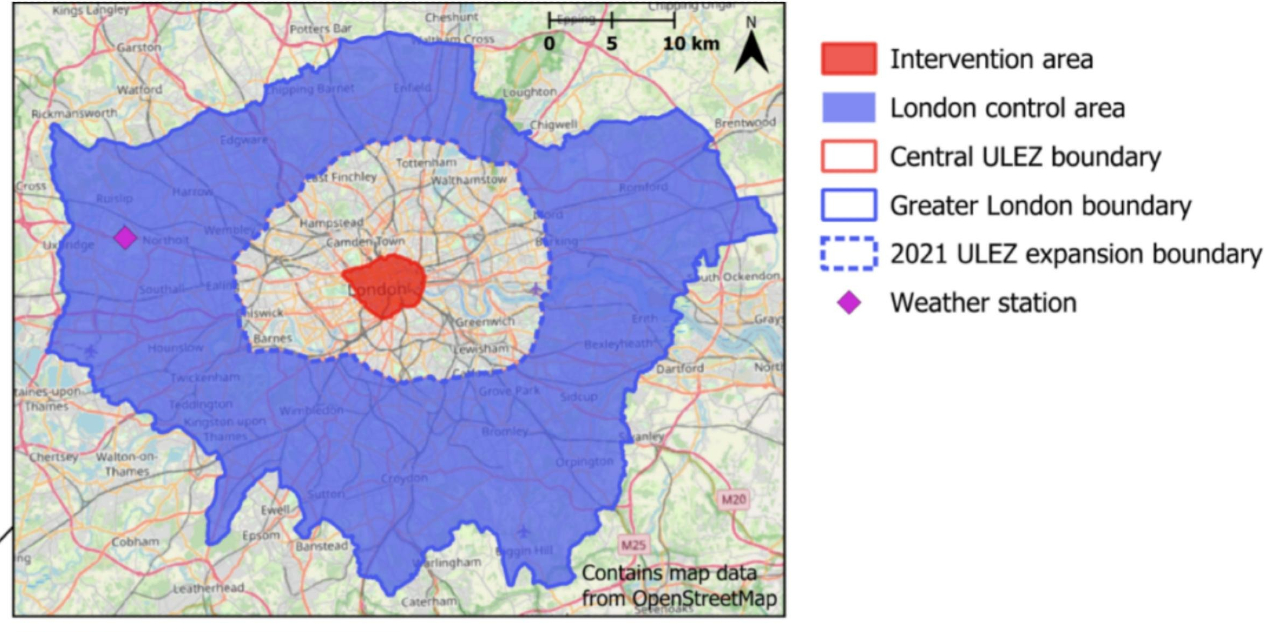
Map of London showing the initial ULEZ zone (red) and the Outer London control zone (blue). (Image credit: Chamberlain et al. 2026).
<関連情報>
- https://www.imperial.ac.uk/news/articles/2026/londons-ulez-and-t-charge-linked-to-reductions-in-emergency-hospital-admissions/
- https://www.sciencedirect.com/science/article/pii/S0160412026002825
車両排出ガス課金区域と成人救急入院との関連性:英国ロンドンの毒性課金区域と超低排出ガス区域に関する中断時系列分析 Association of vehicle emission charging zones with adult emergency hospital admissions: an interrupted time series analysis of the toxicity charge and Ultra Low Emission Zone in London, UK
Rosemary C. Chamberlain, John Hodsoll, Chang Cai, Chris Griffiths, Frank Kelly, Sean Beevers, Gregor Stewart, Marta Blangiardo, Paul Elliott, Bethan Davies, Daniela Fecht
Environment International Available online: 23 May 2026
DOI:https://doi.org/10.1016/j.envint.2026.110324
Abstract
Background
The Toxicity Charge (T-charge) introduced in 2017 in central London, and Ultra-Low Emission Zone (ULEZ) which replaced it in 2019, are vehicle emission-based charging schemes introduced to reduce urban air pollution. There is growing evidence of health co-benefits of such interventions. We conducted a quasi-experimental analysis of these interventions’ impact on the health of adult residents in London.
Methods
We used interrupted time-series (ITS) analyses to quantify associations of the T-charge/ULEZ with changes in rates of adult (≥15 years) emergency hospital admissions (cardiovascular diseases, respiratory diseases, and all-causes excluding external) in residents of the intervention and control (London, Bristol) areas, between 6 January 2014 and 1 March 2020. We conducted ITS analyses using segmented negative binomial regression to model age/sex-standardised admission rates, adjusting for temperature, relative humidity, month, and public holidays.
Findings
We found post-T-charge-introduction reductions in annual trends for cardiovascular (−8.1% [95% CI:−2.2,−13.6] per year), respiratory (−6.2% [−1.5, −10.7] per year), and all-cause (−3.1% [−0.9, −5.2] per year) emergency hospital admissions in the intervention area. After adjusting for concurrent changes in a London control area, reductions remained for cardiovascular (−9.3% [−3.4, −14.9]) and all-cause (−5.1% [−2.5, −7.5]), but not respiratory admissions (−2.7% [−7.6, 2.5]). The short ULEZ period prevented firm conclusions regarding ULEZ changes distinct from the T-charge.
Interpretation
We found evidence of an association between introduction of the T-charge/central ULEZ in London and reduced rates of emergency hospital admissions in adults. Ongoing research is needed to assess longer-term health effects.