2026-11-17 スウォンジー大学
<関連情報>
- https://www.swansea.ac.uk/press-office/news-events/news/2026/11/britain-should-treat-healthy-seas-as-essential-infrastructure-say-scientists.php
- https://www.sciencedirect.com/science/article/pii/S2950160126000616
海洋の複合危機時代において、海洋生態系は不可欠な社会基盤である(Marine ecosystems are essential infrastructure in an era of ocean polycrisis)
Richard K. F. Unsworth, Leanne Cullen-Unsworth, Benjamin L. H. Jones, Carlos M. Duarte.
Nexus, Article 100178, Available online 29 October 2026.
DOI: https://doi.org/10.1016/j.ynexs.2026.100178
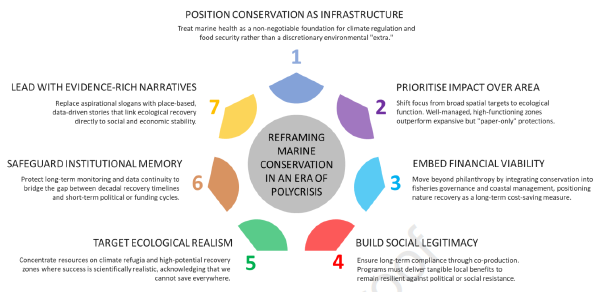
Unsworth et al., “Marine ecosystems are essential infrastructure in an era of ocean polycrisis,” Nexus (2026), DOI: 10.1016/j.ynexs.2026.100178. Licensed under CC BY 4.0.
海洋では、生態系の劣化、経済的不安定、地政学的対立が相互に作用する複合危機が進行しており、従来の海洋保全政策の転換が求められている。過去60年間に世界の海洋上層1,000mの約40%で、水温、塩分、酸素、pHの複合的な変化が生じ、2025年末までに世界のサンゴ礁の84%が記録的な白化現象の影響を受けた。さらに、国際的な環境ガバナンスの分断や各国の国内利益・安全保障の優先が、海洋保全の国際協調を困難にしている。著者らは、海洋生態系を気候調節、食料安全保障、沿岸防護などを支える不可欠な社会基盤として位置づけることを提唱する。その実現に向け、保護区域の面積だけでなく生態系の機能や保全効果を重視し、財政的持続可能性の確保、地域社会との協働、長期的なモニタリング、科学的根拠に基づく情報発信など、7つの構造的な転換策を提示した。海洋保全を短期的な政治・経済情勢に左右されない長期的な社会基盤として確立するための政策的方向性を示している。
This perspective article examines the ocean polycrisis, in which ecological degradation, economic volatility, and geopolitical tensions interact and undermine marine ecosystems and international environmental governance. Over the past 60 years, nearly 40% of the global ocean’s upper 1,000 meters has experienced compound changes in temperature, salinity, oxygen, and pH. By late 2025, 84% of the world’s coral reefs had been affected by the most intense global bleaching event on record. The authors argue that marine conservation must be repositioned as essential infrastructure supporting climate regulation, food security, coastal protection, and human well-being. They propose seven structural changes: positioning conservation as infrastructure, prioritizing ecological impact over protected area size, embedding financial viability, building social legitimacy, targeting ecological realism, safeguarding institutional memory, and leading with evidence-rich narratives. These approaches emphasize long-term monitoring, community co-production, sustainable financing, and measurable ecological and social outcomes. The article calls for a more resilient and socially embedded model of marine conservation that can sustain ecosystem recovery despite political and economic instability.