2026-11-19 東北大学
<関連情報>
- https://www.tohoku.ac.jp/japanese/2026/11/press20261119-03-electrification.html
- https://pubs.aip.org/aip/pof/article/38/11/117417/3408881/Drop-spray-electrification
液滴噴霧の帯電(Drop spray electrification)
Riko Kazama, Masaya Toda, Hans-Jürgen Butt, Rutvik Lathia
Physics of Fluids 38, 117417 (2026):2026-11-17
DOI:https://doi.org/10.1063/5.0355532
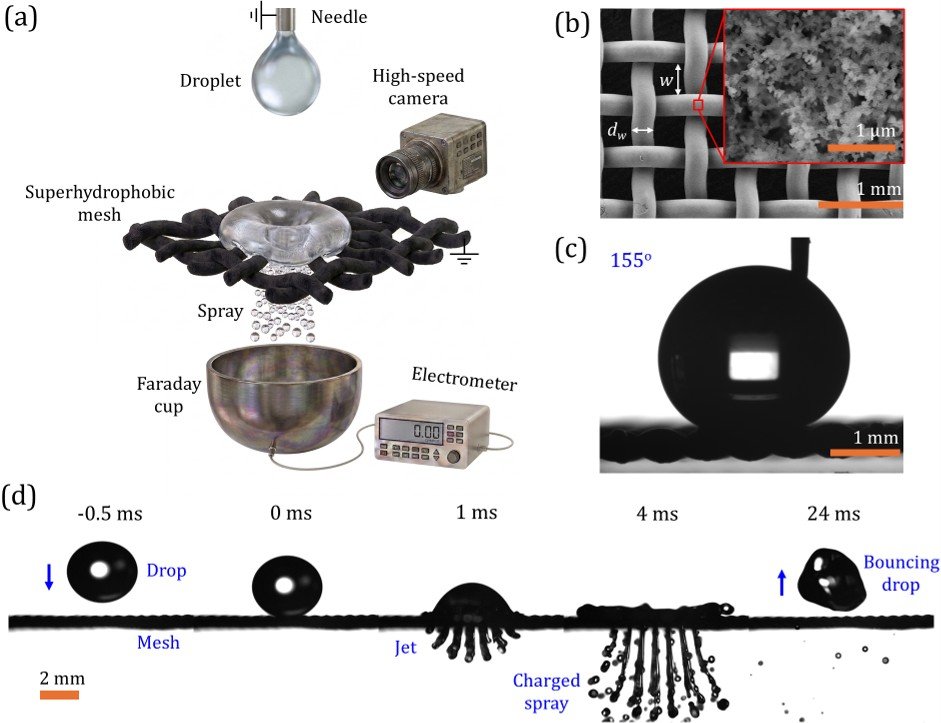
FIG. 1.(a) Experimental setup for drop impact on superhydrophobic meshes and measurement of charge from spray. (b) SEM image of a steel mesh (ω= 400μm, and dω = 330 μm) with a superhydrophobic coating. Inset: structures on mesh at micro-nano scales. (c) Static contact angle measurement for the superhydrophobic steel mesh. (d) High-speed images of 25 μl drop impact on steel mesh at We ∼ 100.© Kazama et al., 2026. Licensed under [CC BY 4.0]
Charge separation during droplet impact and fragmentation has long been recognized, but the relationship between spray formation and electrification on superhydrophobic meshes has remained unclear. In this study, water drops were impacted onto superhydrophobic metal and polymer meshes, and the resulting spray was investigated using Faraday-cup charge measurements and high-speed imaging. The results revealed that no measurable charge was generated before liquid penetration through the mesh. At low Weber numbers, charging was dominated by recoil jets formed during droplet retraction; at intermediate values, both recoil and impact-induced jets contributed; and at high Weber numbers, impact-induced penetration became the dominant mechanism. Reducing the mesh pore size increased the charge-to-spray-mass ratio by nearly an order of magnitude. Conductive meshes also maintained stable charging during repeated impacts by dissipating residual surface charge. Salt concentration and coating durability further influenced charging performance. The maximum mass-normalized power output was approximately 28 nW/g of collected spray at an external load resistance of 1 GΩ, indicating that further optimization and improved durability are required for practical energy harvesting. These findings provide fundamental design principles for passive charge collection and potential rain-driven energy-harvesting systems.