2026-11-18 京都大学
<関連情報>
- https://www.kyoto-u.ac.jp/ja/research-news/2026-11-18
- https://royalsocietypublishing.org/rspb/article/293/2083/20262106/484218/Socioecological-factors-shaping-the-ontogenetic
シクリッド類における兄弟間葛藤の成長過程に伴う変化を形作る社会生態学的要因
Socioecological factors shaping the ontogenetic trajectories of sibling conflict among lamprologine cichlids
Shun Satoh, Hiroki Hata, Atsushi Maruyama, Taiga Saeki, Bosco Rusuwa, Richard Zatha, Lawrence Makasa, Yoshio Yuki, Masaya Morita, Seiya Okuno
Proceedings of the Royal Society B: Biological Sciences, 293(2083), 20262106 公開日:2026-11-19
DOI:10.1098/rspb.2026.2106
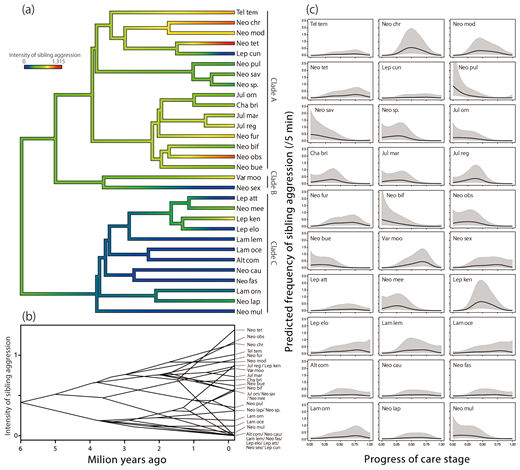
Phylogenetic diversification of sibling aggression intensity and its ontogenetic trajectories in Lake Tanganyika cichlids. (a) Ancestral-state reconstruction of total aggression intensity. (b) Phenogram illustrating the divergence of aggression intensity and evolutionary changes in aggression intensity over time. Clades A–C were designated for convenience to facilitate discussion of phylogenetic variation in sibling aggression in the main text. (c) Ontogenetic trajectories of sibling aggression across developmental progress. Aggression values were estimated using a Bayesian phylogenetic generalized additive mixed model (PGAMM) based on data from 1312 juveniles representing 30 Lamprologini cichlid species. CC BY 4.0
本研究は、アフリカのタンガニーカ湖とマラウイ湖に生息するシクリッド類を対象に、兄弟間の攻撃行動(兄弟間葛藤)が成長過程でどのように変化し、生態環境や社会構造によってどう左右されるかを調べたものである。研究チームは水中カメラを用いて52種、1,892個体の稚魚を観察し、兄弟への攻撃行動、体サイズ、採餌場所、巣周辺の稚魚密度などを記録した。その結果、明瞭な兄弟間葛藤はタンガニーカ湖固有のLamprologini族で確認された。さらに30種、1,312個体のデータを用いた系統比較解析から、湖底の餌資源に依存する種ほど兄弟間の攻撃が頻繁であり、同じ巣の周辺にいる稚魚の密度が高いほど攻撃が減少する傾向が明らかになった。また、母親だけが子育てを行う種では湖底資源への依存と兄弟間葛藤が強く、両親が協力して子育てする種では攻撃行動が観察されなかった。さらに、集団生活をする種では発達初期、集団生活をしない種では発達後期に葛藤が生じやすい傾向が示された。本研究は、兄弟間の競争が食物資源、個体密度、親の養育戦略などの相互作用によって形成されることを示している。
※京都大学の研究発表資料に基づく要約。
This study investigated how sibling conflict changes during development and how ecological and social factors influence aggressive interactions among cichlid fishes inhabiting Lakes Tanganyika and Malawi in Africa. Using underwater cameras, the researchers observed 1,892 juvenile individuals from 52 species and recorded sibling aggression, body size, feeding locations, and juvenile density around nests. Clear sibling conflict was identified only in the Lamprologini tribe endemic to Lake Tanganyika. Further phylogenetic comparative analyses involving 1,312 individuals from 30 species revealed that sibling aggression was more frequent in species relying on food resources from the lake bottom, whereas aggression tended to decrease with increasing juvenile density around the same nest. Species in which only mothers provided parental care showed greater dependence on lake-bottom resources and more intense sibling conflict, while aggression was not observed in species receiving cooperative care from both parents. The developmental timing of sibling conflict also differed according to social organization: aggression tended to occur earlier in group-living species and later in non-group-living species. These findings indicate that sibling conflict is shaped by interactions among ecological conditions, resource competition, population density, and parental care strategies.