2026-11-18 東京大学
<関連情報>
- https://www.a.u-tokyo.ac.jp/topics/topics_20261118-1.html
- https://www.nature.com/articles/s41437-026-00895-w
日本列島周辺における西太平洋産アワビの北方系・南方系亜種を示す集団ゲノム学的証拠
Population genomic evidence of northern and southern subspecies of western Pacific abalones around Japanese archipelago
Shotaro Hirase, Toyonobu Fujii, Masashi Sekino, Motoyuki Hara, Kiyoshi Kikuchi
Heredity(2026)公開日:2026-11-18
DOI:10.1038/s41437-026-00895-w
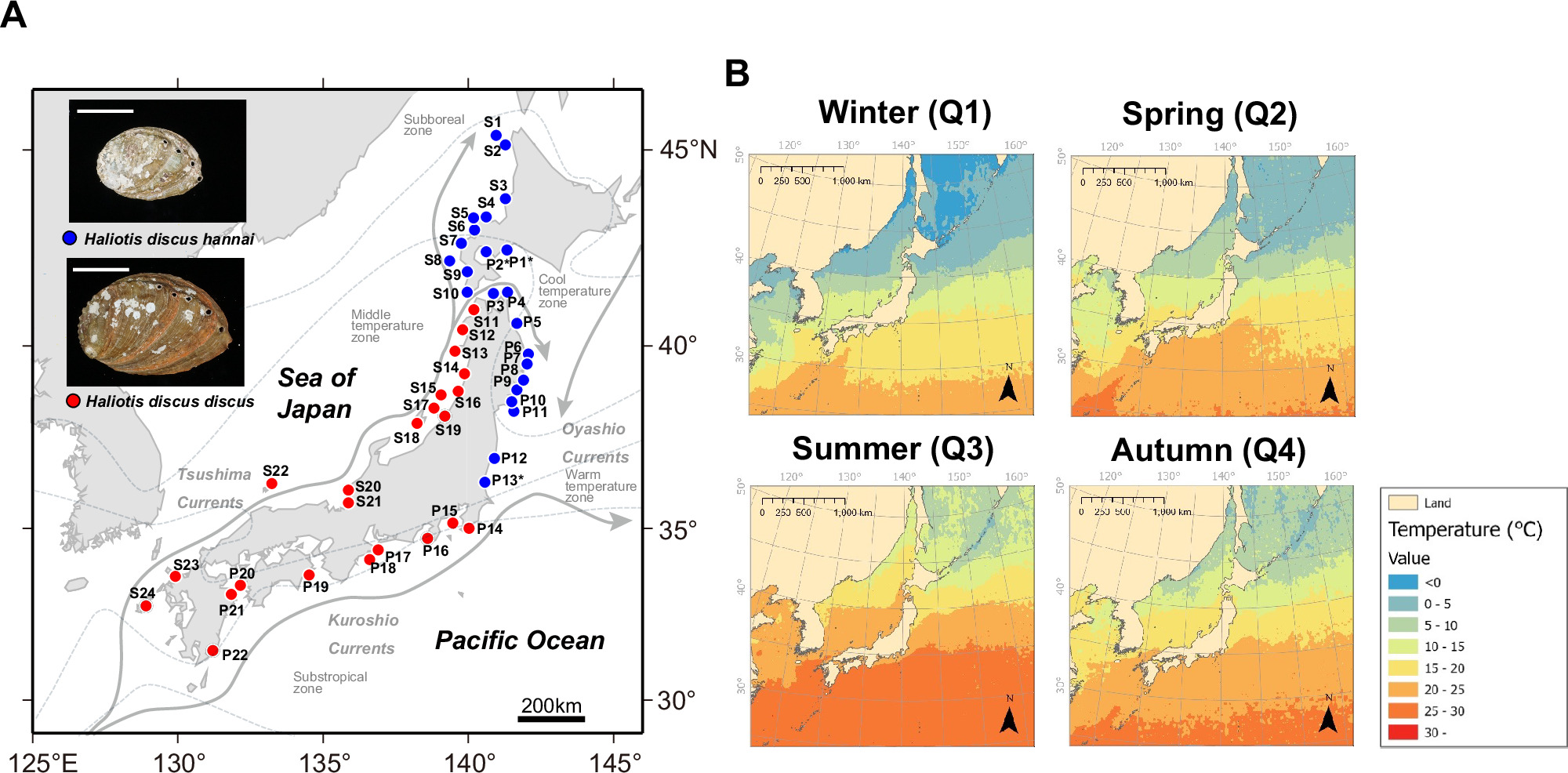
Fig. 1: Sampling locations and sea surface temperature along the coastline of the Japanese archipelago.From: Population genomic evidence of northern and southern subspecies of western Pacific abalones around Japanese archipelago CC BY 4.0
This study investigated whether two Japanese abalone subspecies, the northern abalone (Haliotis discus hannai) and the southern abalone (Haliotis discus discus), represent genetically differentiated populations around the Japanese archipelago. Although these subspecies have traditionally been distinguished by shell morphology and geographic distribution, whether these differences reflect independent evolutionary histories or environmentally induced variation has remained controversial. The researchers conducted high-resolution population genomic analyses combining microsatellite DNA and single-nucleotide polymorphism (SNP) markers. They also examined associations between genetic differentiation and 33 environmental variables characterizing Japanese coastal habitats, including water temperature, salinity, dissolved oxygen, nutrient concentrations, and coastal geography. The analyses identified two distinct genetic groups corresponding to the northern and southern subspecies, demonstrating that they are differentiated at the genomic level. Their genetic divergence was also significantly associated with environmental conditions across their respective distributions. These findings support the interpretation that the two subspecies have distinct evolutionary backgrounds and patterns of environmental adaptation. The results provide an important scientific basis for abalone conservation, stock enhancement programs, and geographically informed fisheries resource management.