2026-11-05 合肥物質科学研究院(HFIPS)
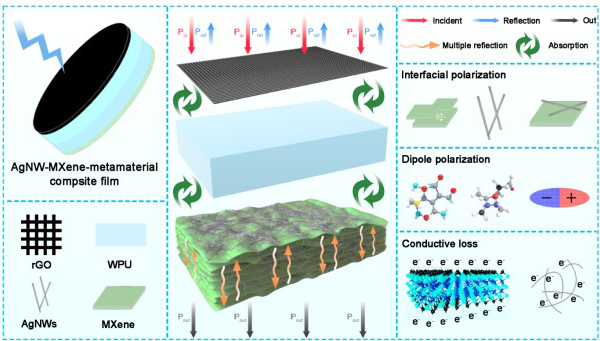
Electromagnetic control mechanism of square-meter-scale electromagnetic control films. (Image by JI Shulin)
<関連情報>
- https://english.hf.cas.cn/nr/bth/202611/t20261105_1213245.html
- https://pubs.acs.org/aamick/article-abstract/18/43/59430/5456494/Cross-Dimensional-Percolation-and-Metastructure
- https://pubs.acs.org/langd5/article-abstract/42/31/22513/5236326/Interface-Strengthening-of-Brittle-AgNW-MXene
異次元浸透とメタ構造を利用した高効率電磁干渉遮蔽フィルム Cross-Dimensional Percolation and Metastructure-Assisted Highly Efficient Electromagnetic Interference Shielding Films
Qingyang Zeng; Zhenhua Zhong; Qianru Ge; Xinhao Bao; Shulin Ji
ACS Applied Materials & Interfaces Published:October 22, 2026
DOI:https://doi.org/10.1021/acsami.6c11426
Abstract
Increasing electromagnetic interference (EMI) issues make shielding materials urgent in need. However, designing a thin/lightweight material with high shielding effectiveness (SE over 100 dB) by facile and scalable technologies with high production accuracy is still challenging. Herein, excellent shielding composite films are successfully prepared through sequential scalable positive pressure filtration, accurate inkjet printing, and facile transferring. From mass ratio optimization of 1D silver nanowires to 2D MXene, a skeleton with maximum inner free space and fast electron and phonon transport channels through cross-dimensional percolation is produced for internal multiple reflection absorption. To further increase EMI SE, graphene-based mesh metamaterials are theoretically calculated and accurately printed with controlled conductivity for impedance matching as the top layer. Facile inkjet printing succeeds in balancing print accuracy and conductivity control by advanced ink formulation. Finally, under multiple attenuation mechanisms verified through complex permittivity analysis in both frequency domain and real space (conductive loss, dipole polarization, and various interfacial polarizations), EMI SE of 102.31 dB in X-band is achieved. Integrating different attenuation technologies in a single material system of multidimensions inspires further designing shielding materials with increasingly strict requirements like multiband compatibility with special frequency enhancement.
PVAまたはWPUポリマーを用いた脆性AgNW-MXene複合フィルムの界面強化による柔軟な電磁干渉シールド用途への応用 Interface Strengthening of Brittle AgNW-MXene Composite Films through PVA or WPU Polymers for Flexible Electromagnetic Interference Shielding Applications
Qingyang Zeng; Qianru Ge; Shulin Ji
Langmuir July 28, 2026
DOI:https://doi.org/10.1021/acs.langmuir.6c01002
Abstract
In electromagnetic interference (EMI) shielding applications, high shielding effectiveness and good mechanical properties are extensively required considering conformal or foldable use. However, the natural brittleness of efficient shielding materials like layered structure hinders their widespread application and mechanisms behind these fragile films need in-depth study. Herein, silver nanowire-transition metal carbide nanosheet composite films with 63.93 dB under 4.02 μm are first prepared through mass ratio optimization. Polymers incorporated into the brittle nanowire-nanosheet system are designed through simultaneous positive pressure filtration with nanowires and nanosheets. It further increases the shielding effectiveness owing to impedance matching through conductivity adjustment; more importantly, the flexibility and property stability of films are significantly enhanced to withstand 3000 bending cycles, maintaining values of 58.81 and 63.00 dB for nanowire-nanosheet/poly(vinyl alcohol) and nanowire-nanosheet/waterborne polyurethane, respectively. Next, mechanisms of interface strengthening through polymer incorporation are thoroughly investigated through in-depth Fourier transform infrared and X-ray photoelectron spectroscopy analysis, cross-link density tests, as well as microstructure characterization. Polymers synergistically strengthen the microscopic interface through hydrogen-bond network formation and chain segment motion, providing elastic recovery properties. This work provides a viable strategy to design and fabricate flexible, lightweight, and high-performance shielding materials for many advanced fields.