2026-10-28 コロンビア大学
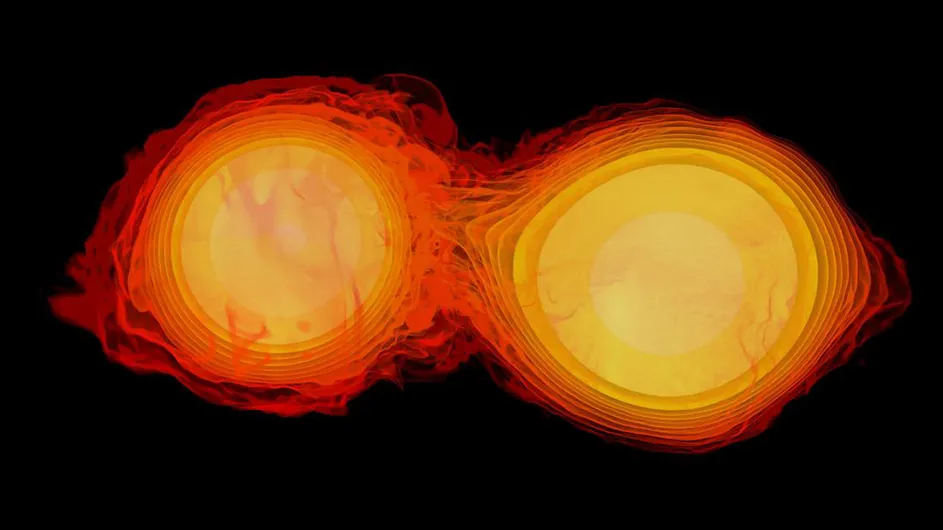
Columbia researcher Luca Comisso’s new finding on “gravitational reconnection” could help explain cosmic events like the merger of two neutron stars into a black hole, shown here in a supercomputer simulation. Image: NASA’s Goddard Space Flight Center.
<関連情報>
- https://news.columbia.edu/news/can-gravitational-fields-break-and-reconnect-einsteins-equations-suggest-they-can
- https://journals.aps.org/prd/abstract/10.1103/lmqy-pf9k
- https://journals.aps.org/prl/abstract/10.1103/6c4q-kx6f
重力場の再結合 Reconnection of gravitational fields
Luca Comisso and Felipe A. Asenjo
Physical Review D Published: 28 October, 2026
DOI:https://doi.org/10.1103/lmqy-pf9k
Abstract
In a tetrad formulation of general relativity, an ideal Ohm-type condition for the gravitational field implies the conservation of gravitational fluxes and the preservation of the connectivity of gravitational field sheets. We investigate the consequences of departures from ideal gravitational evolution by developing a theory of gravitational reconnection, defined as a change in the connectivity of gravitational field sheets arising from the breakdown of the ideal frozen-in evolution of the gravitational field. We derive quantitative measures of the gravitational reconnection rate, show that gravitational reconnection alters the energy-momentum exchange between the gravitational and matter sectors, and determine how it modifies the evolution of gravitational helicity. Our results provide a quantitative framework for describing changes in gravitational connectivity and their consequences in dynamical spacetimes.
凍結された重力場 Frozen-In Gravitational Fields
Felipe A. Asenjo, Maricarmen A. Winkler, and Luca Comisso
Physical Review Letters Published: 22 April, 2026
DOI:https://doi.org/10.1103/6c4q-kx6f
Abstract
Spacetime can undergo complex nonlinear evolution, as governed by the Einstein field equations, and a central challenge is to understand the geometric structures that arise, persist, and interact throughout its evolution. Using a formulation of Einstein equations that parallels nonlinear electrodynamics of continuous media, we show that general relativity admits gravitational field connections—two-surfaces and associated field lines whose connectivity is maintained by the spacetime dynamics. This gravitational frozen-in behavior is enabled by an ideal Ohm-type condition for the gravitational field. We further show that the same framework naturally leads to a conserved “gravitational magnetic” flux. A conserved gravitational helicity also emerges, with a clear topological interpretation in terms of gravitational field-line structures. These results identify well-defined topological constraints on admissible spacetime evolution and provide an organizing principle underlying the nonlinear dynamics of spacetime.