2026-10-26 愛媛大学
<関連情報>
- https://www.ehime-u.ac.jp/data_relese/pr_20261026_rcsce/
- https://iopscience.iop.org/article/10.3847/2041-8213/aea070
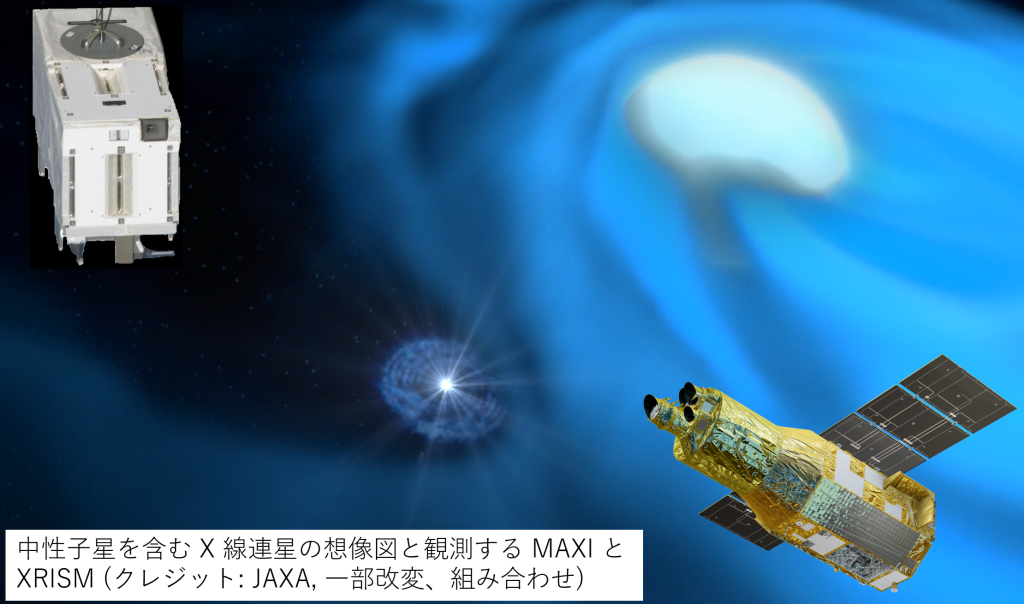
XRISM/Resolve が明らかにした Be 型 X 線連星パルサー 1A 1118-61 のアウトバーストにおける中性鉄輝線の形 XRISM/Resolve Reveals the Profiles of Neutral Iron Emission Lines in an Outburst X-Ray Spectrum of the Be/X-Ray Binary Pulsar 1A 1118-61
Toshihiro Takagi, Megumi Shidatsu, Motoki Nakajima, Mutsumi Sugizaki, Tatehiro Mihara, Camille M. Diez, Gabriele A. Matzeu, and Simon Dupourqué
The Astrophysical Journal Letters Published: 2026 September 15
DOI:10.3847/2041-8213/aea070
Abstract
We report on the high-resolution X-ray spectroscopy of the Be/X-ray binary pulsar (BeXBP) 1A 1118−61 during the outburst in 2026 January–February with X-Ray Imaging and Spectroscopy Mission (XRISM)/Resolve. We have successfully resolved the structure of neutral Fe Kα emission lines (including Kα1 and Kα2) and found that they consist of two distinct components with line widths of σ ∼ 2 eV (∼100 km s−1) and σ ∼ 40 eV (∼2000 km s−1). The Resolve data also allow us to perform pulse-phase-resolved spectroscopy. For the narrow (σ ∼ 2 eV) component, the line flux and equivalent width vary with the pulse phase, whereas its centroid energy and width do not. In contrast, for the broad (σ ∼ 40 eV) line component, the centroid energy and width show pulse-phase dependence, while the line flux and equivalent width do not show significant changes. These results suggest that the broad Fe Kα emission likely originates from the inner region of the accretion disk truncated near the magnetospheric radius, while the narrow Fe Kα emission may arise from the Be star and/or its surrounding circumstellar disk.