2026-10-22 コロンビア大学
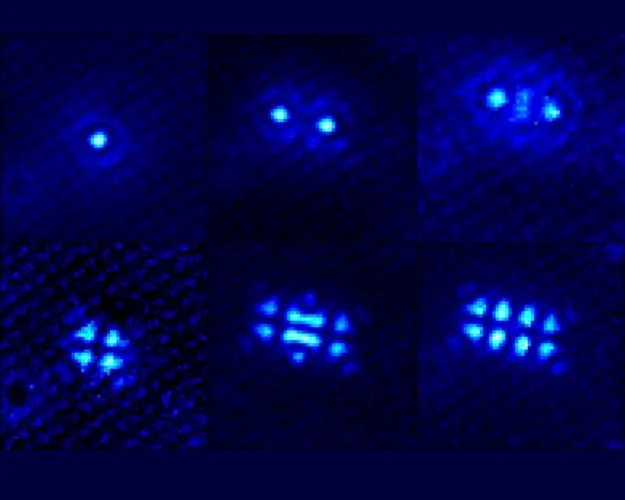
Spectroscopic images of the 2D metal Pd5AlI2 revealing bound electron waves around atomic defects. These are the first observations of a bound state in the continuum (BIC) in a metal. Credit: Morgan Thinel, Pasupathy Lab/Columbia University
<関連情報>
- https://quantum.columbia.edu/news/quantum-interference-key-catching-electron-waves
- https://www.science.org/doi/10.1126/science.adt9825
- https://www.nature.com/articles/s41567-025-02953-2
二次元金属における連続スペクトル内の電子束縛状態 Electronic bound states in the continuum in a two-dimensional metal
Morgan Thinel, Xiong Huang, Daniel G. Chica, Simon Turkel, […] , and Raquel Queiroz
Science Published:22 Oct 2026
DOI:https://doi.org/10.1126/science.adt9825
Abstract
Bound states in the continuum (BICs) are quantum states that remain localized despite lying within a continuum of extended, delocalized states. Whereas optical BICs have been realized in photonic systems, achieving electronic bound states embedded in a metallic background remains an ongoing challenge. In this study, we used scanning tunneling microscopy to identify two defect-induced electronic states that remain localized within the metallic continuum of Pd5AlI2, a two-dimensional van der Waals metal. Our calculations suggest that electron-hopping interference on the decorated checkerboard lattice of Pd5AlI2 gives rise to a (quasi) flat band built from spatially localized eigenstates that are orthogonal to the dispersive continuum. Atomic defects within this frustrated lattice shift the associated flat-band localized states into the metallic continuum, forming robust, symmetry-protected BICs.
二次元格子における軌道配置からの電子のフラストレーション Frustrated electron hopping from the orbital configuration in a two-dimensional lattice
Aravind Devarakonda, Christie S. Koay, Daniel G. Chica, Morgan Thinel, Asish K. Kundu, Zhi Lin, Alexandru B. Georgescu, Sebastian Rossi, Sae Young Han, Michael E. Ziebel, Madisen A. Holbrook, Anil Rajapitamahuni, Elio Vescovo, Kenji Watanabe, Takashi Taniguchi, Milan Delor, Xiaoyang Zhu, Abhay N. Pasupathy, Raquel Queiroz, Cory R. Dean & Xavier Roy
Nature Physics Published:07 August 2025
DOI:https://doi.org/10.1038/s41567-025-02953-2
Abstract
Electron hopping on spatially periodic lattices gives rise to intriguing electronic behaviour. For example, hopping on the geometrically frustrated two-dimensional kagome, dice and Lieb lattices yields electronic band structures with both massless Dirac-like and perfectly dispersion-less, flat bands. As materials featuring the dice and Lieb lattice structures are scarce, an alternative approach proposes to leverage atomic orbitals to realize the characteristic electron hopping of geometrically frustrated lattices. This strategy promises to expand the list of candidate materials with frustrated electron hopping, but is yet to be shown in experiments. Here we demonstrate frustrated hopping in the van der Waals intermetallic Pd5AlI2, emerging from the arrangement of atomic orbitals in a primitive square lattice. Using angle-resolved photoemission spectroscopy and quantum oscillation measurements, we reveal that the band structure of Pd5AlI2 includes linear Dirac-like bands intersected at their crossing point by a locally flat band—an essential characteristic of frustrated hopping in Lieb and dice lattices. Moreover, this compound shows exceptional chemical stability, with its unusual bulk band structure and metallicity persisting in ambient conditions down to the monolayer limit. Hence, our results showcase a way to realize electronic structures characteristic of geometrically frustrated lattices in non-frustrated systems.