
2026-10-26 東京科学大学
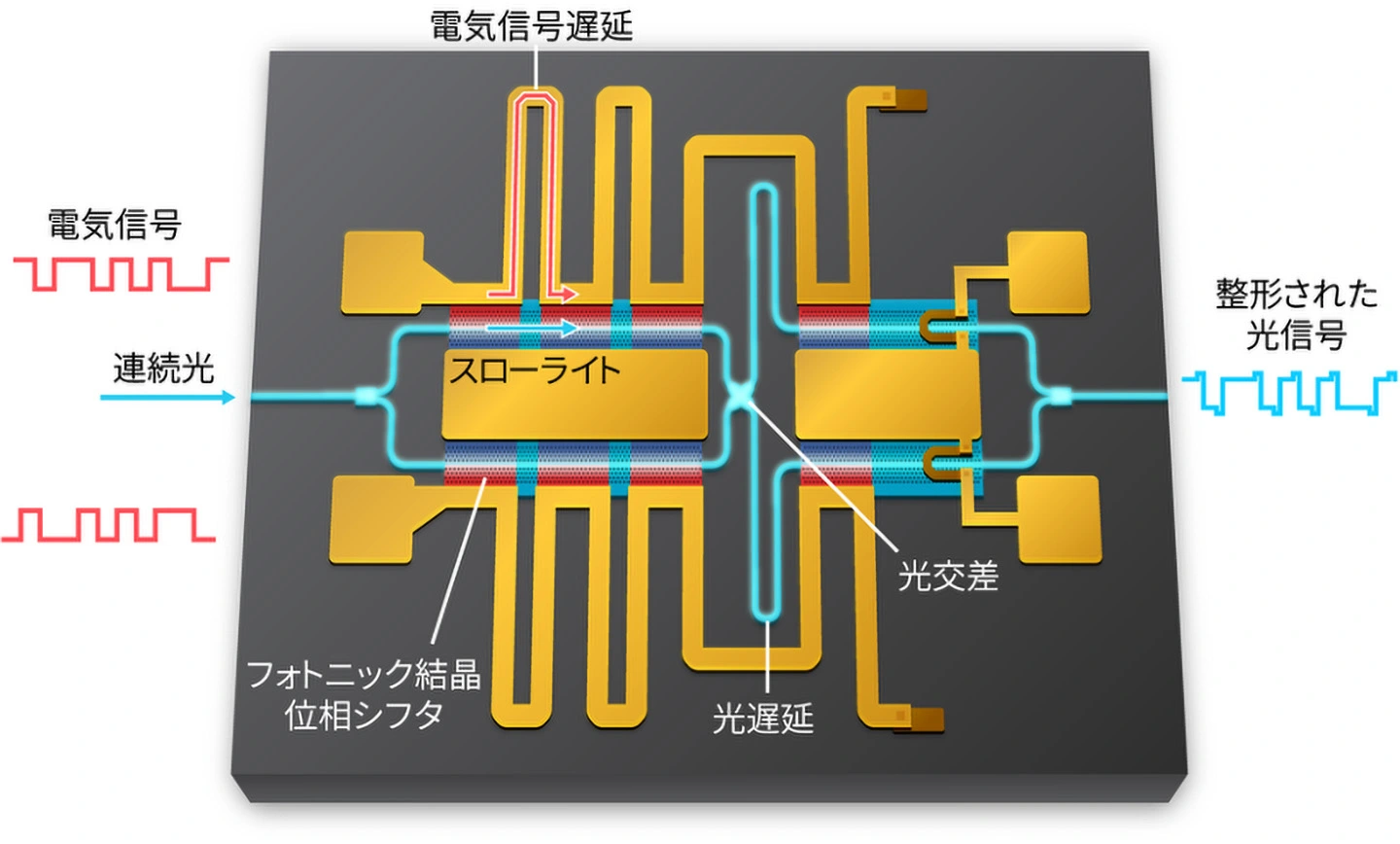
図1. 電気光学イコライザを内蔵したスローライト光変調器。光の経路(水色)に遅延と交差を設けることで、信号波形を整形する。金色は電極を示す。(原論文の図より引用)
<関連情報>
内蔵EOイコライザーにより実現された、DSP負荷低減型200G/λ低電圧スローライトシリコン変調器 Reduced-DSP 200G/λ low-voltage slow-light silicon modulator enabled by built-in EO equalizer
Keisuke Kawahara, Tai Tsuchizawa, Noritsugu Yamamoto, Yuriko Maegami, Koji Yamada, Nobuhiko Nishiyama & Toshihiko Baba
Nature Communications Published:22 October 2026
DOI:https://doi.org/10.1038/s41467-026-78128-1
Abstract
Multi-Tb/s optical interconnects for artificial intelligence data centers necessitate high-speed, energy-efficient, and compact transceivers. However, conventional silicon Mach-Zehnder modulators are fundamentally limited by low modulation efficiency and large physical dimensions that typically extend several millimeters, requiring high-swing drivers and power-intensive digital signal processing to achieve data rates exceeding 100 Gb/s per lane. Here we show a silicon photonic crystal waveguide slow-light modulator that overcomes the bandwidth-efficiency trade-off via a built-in electro-optic equalizer. By monolithically integrating optical delay lines and crossings within segmented slow-light phase shifters, we synthesized an on-chip feedforward response that extends the 3-dB bandwidth. The fabricated modulator with a small device length of 320 µm demonstrated 140-Gb/s on-off keying operation with an energy consumption of 26 fJ/bit using drive voltages compatible with fin field-effect transistor-based complementary metal-oxide-semiconductor technology. Furthermore, four-level pulse amplitude modulation achieved 180 Gb/s without digital signal processing and 200 Gb/s with a low-complexity 11-tap digital equalizer. By reducing reliance on power-dissipating electronics, this strategy provides a potential route toward future dense multi-Tb/s co-packaged optics for energy-constrained switching systems.

