2026-10-14 東北大学
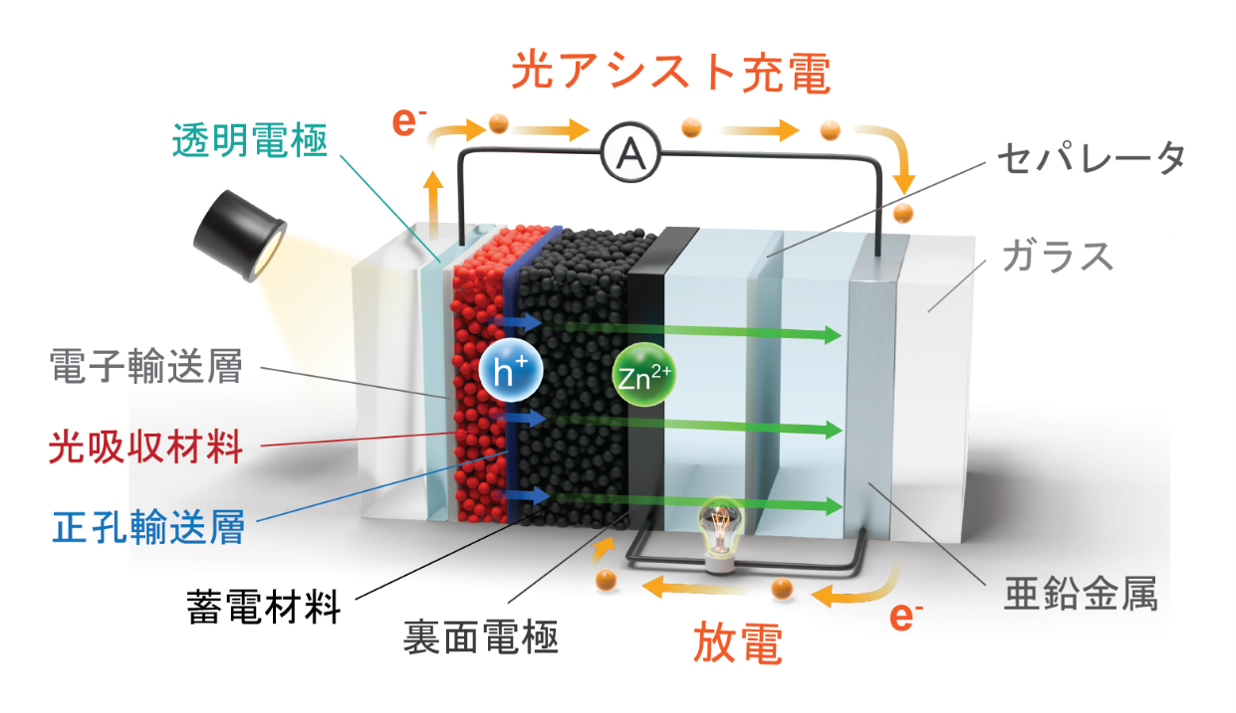
図1. 本研究で構築した積層型光電極を用いた光蓄電池。
<関連情報>
- https://www.tohoku.ac.jp/japanese/2026/10/item20261014-02-photobattery.html
- https://pubs.acs.org/nalefd/article/doi/10.1021/acs.nanolett.6c02373/5449469/Photobattery-Architectures-to-Suppress-Charge
電荷再結合を抑制する光電池アーキテクチャ Photobattery Architectures to Suppress Charge Recombination
Kohei Shimokawa;Byung-Man Kim;Arvind Pujari;Hooman Abbasi;Tetsu Ichitsubo;Michael De Volder
Nano Letters Published:October 13, 2026
DOI:https://doi.org/10.1021/acs.nanolett.6c02373
Abstract
Integrating solar energy conversion and storage into single-unit photobatteries offers compact energy supplies. However, achieving sufficient photovoltage to charge batteries without external bias remains a critical bottleneck for these devices. Here, we demonstrate that the photovoltage in Zn-ion photobatteries can be modulated and enhanced by selecting and structuring the photoactive materials strategically. Randomly dispersed electrode configurations are easy to manufacture but they can suffer from charge recombination. In our experiments, these yielded a negligible photovoltage of ∼0.01 V. In comparison, our proposed layer-by-layer design, integrating a solid-state dye-sensitized solar cell (DSSC) with an optimized spinel Zn–Mn oxide cathode, increased the photovoltage output to ∼1 V under 1-sun illumination. This dramatic performance enhancement is achieved by better control over interfaces and charge transport and establishes a strategy for improving the architecture of future photobatteries.