2026-10-08 ワシントン大学セントルイス校
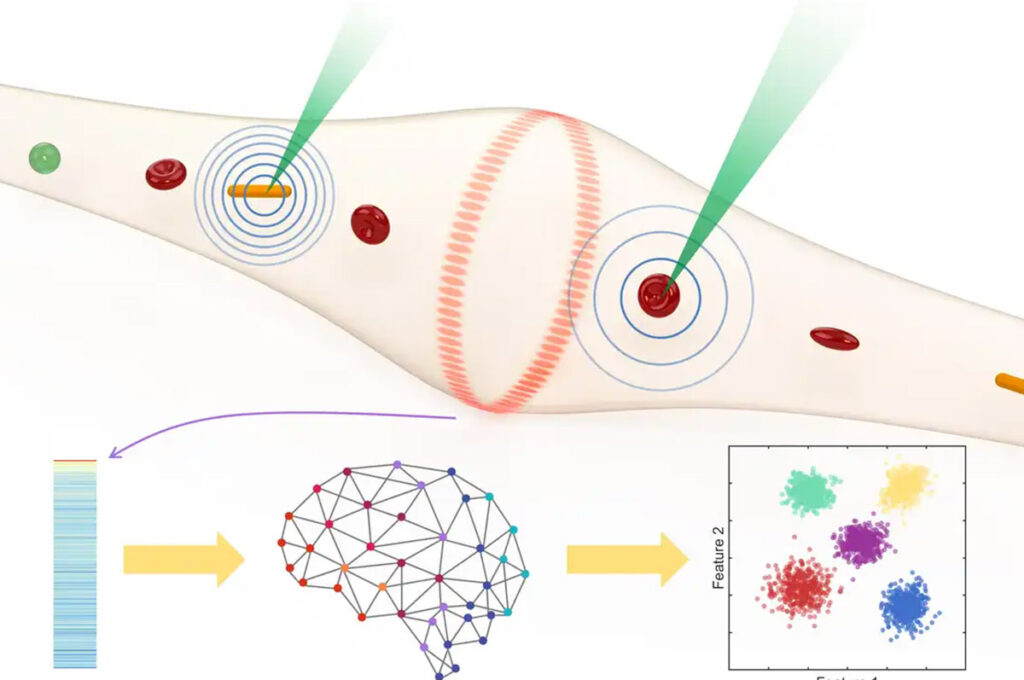
Lan Yang’s lab has unlocked new capabilities for whispering-gallery-mode-based sensors by extending the range beyond the immediate surface while preserving the exceptional sensitivity that has made these sensors so powerful. (Image: Yang lab)
<関連情報>
- https://source.washu.edu/2026/10/new-sensor-detects-classifies-freely-flowing-particles-without-labels/
- https://www.nature.com/articles/s41377-025-01978-9
光音響特性による自由流動ナノ粒子および細胞の検出と分類のためのウィスパリングギャラリーモード共振器 Whispering-gallery-mode resonators for detection and classification of free-flowing nanoparticles and cells through photoacoustic signatures
Jie Liao, Maxwell Adolphson, Hangyue Li, Dipayon Kumar Sikder, Chenyang Lu & Lan Yang
Light: Science & Applications Published:11 December 2025
DOI:https://doi.org/10.1038/s41377-025-01978-9
Abstract
Micro and nanoscale particles have played crucial roles across diverse fields, from biomedical imaging and environmental processes to early disease diagnosis, influencing numerous scientific research and industrial applications. Their unique characteristics demand accurate detection, characterization, and identification. However, conventional spectroscopy and microscopy commonly used to characterize and identify tiny objects often involve bulky equipment and intricate, time-consuming sample preparation. Over the past two decades, optical micro-sensors have emerged as a promising sensor technology with their high sensitivity and compact configuration. However, their broad applicability is constrained by the requirement of surface binding for selective sensing and the difficulty in differentiating between various sensing targets, which limits their application in detecting targets in their native state or in complex biological samples. Developing label-free and immobilization-free sensing techniques that can directly detect target particles in complex solutions is crucial for overcoming the inherent limitations of current biosensors. In this study, we design and demonstrate an optofluidic, high throughput, ultra-sensitive optical microresonator sensor that can capture subtle acoustic signals, generated by tiny particles from the absorption of pulsed light energy, providing photoacoustic spectroscopy information for real-time, label-free detection and interrogation of particles and cells in their native solution environments across an extended sensing volume. Leveraging unique optical absorption of the targets, our technique can selectively detect and classify particles flowing through the sensor systems without the need for surface binding, even in a complex sample matrix, such as whole blood samples. We showcase the measurement of gold nanoparticles with diverse geometries and different species of red blood cells in the presence of other cellular elements and a wide variety of proteins. These particles are effectively identified and classified based on their photoacoustic fingerprint that captures particle shape, composition, molecule properties, and morphology features. This work opens up new avenues to achieve rapid, reliable, and high-throughput particle and cell identification in clinical and industrial applications, offering a valuable tool for understanding complex biological and environmental systems.