2026-10-05 東北大学
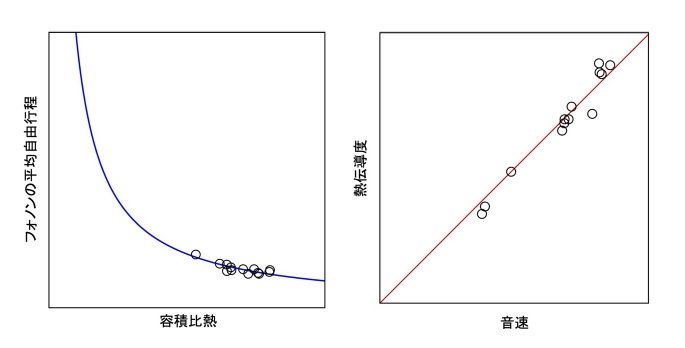
図1. (左) 室温におけるケイ酸塩ガラスの容積比熱とフォノンの平均自由行程の関係の模式図 (右) 室温におけるケイ酸塩ガラスの熱伝導度と音速の関係の模式図 (Reproduced with permission from Appl. Phys. Lett., (2026). Copyright 2026, American Institute of Physics.)
<関連情報>
- https://www.tohoku.ac.jp/japanese/2026/10/press20261005-02-glasses.html
- https://pubs.aip.org/aip/apl/article-abstract/129/13/132203/3405557/Dominant-role-of-sound-velocity-in-the-thermal
ケイ酸塩ガラスの熱伝導率における音速の支配的な役割
Dominant role of sound velocity in the thermal conductivity of silicate glasses
Sohei Sukenaga;Bunta Ozato;Hiroyuki Shibata
Applied Physical Letters Published:September 30 2026
DOI:https://doi.org/10.1063/5.0351403
Assuming that the phonon acts as the main heat carrier in silicate glasses, the thermal conductivity of glass is related to the product of volumetric heat capacity, phonon mean free path, and sound velocity. However, the dominant parameter in this relationship remains unclear. In this study, we evaluate the correlation between sound velocity and thermal conductivity for the 13 types of binary silicate glasses [i.e., M2/nO–SiO2 (M: Li, Na, Ca, or Pb; n: valence number of the M cation)] at a temperature of approximately 298 K. We find that thermal conductivity is linearly correlated with sound velocity and can be approximated as λ=3.0×10⁻⁴ν, where ν is the sound velocity (m s−1), and λ is the thermal conductivity (W m−1 K−1). Our findings highlight the possibility of designing the thermal conductivity of silicate glasses by focusing on a single parameter (i.e., sound velocity), which can be measured and predicted using the established methodology.