2026-10-02 テキサスA&M大学
<関連情報>
- https://today.tamu.edu/news/2026/10/02/research-advances-brain-inspired-computing-materials/
- https://pubs.acs.org/jacsat/article/148/17/18346/5139778/Ion-Electron-Coupling-Driven-Redox-Behavior-in
金属有機構造体におけるイオン-電子結合駆動型酸化還元挙動 Ion-Electron Coupling-Driven Redox Behavior in Metal–Organic Frameworks
A. Avilés;M. Ghotbi;A. J. Ferguson;J. L. Blackburn;A. A. Talin;M. Y. Darensbourg;P. B. Balbuena
The Journal of the American Chemical Society Published:April 21, 2026
DOI:https://doi.org/10.1021/jacs.6c03704
Abstract
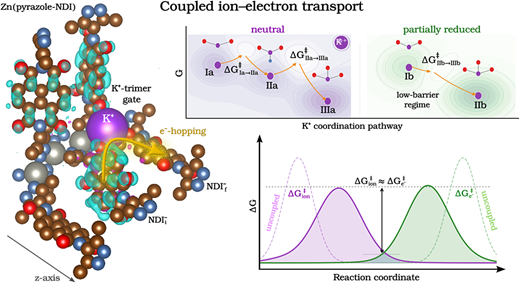
Redox-active metal–organic frameworks (MOFs) have long been proposed as electronic transport platforms, yet the microscopic origin of their conductivity remains debated. A theoretical demonstration reveals charge transport in a Zn(pyrazole–naphthalene diimide (NDI)) MOF arising not from delocalized band-like states but from redox hopping between discrete linker sites. Using ab initio molecular dynamics simulations combined with electronic structure analysis, we established a direct link among electron injection, structural reorganization, and transport. Electron accumulation proceeds sequentially and site-selectively from imide and carbonyl groups of the NDI core progressively involving pyrazole N atoms at higher reduction states, through a hierarchy of redox-active sites. In contrast, Zn nodes remain essentially redox-inactive, which confirms their structural role. Density-of-states analysis corroborates a transport regime dominated by linker-centered states with evolving p-character upon reduction, resulting in dynamically reconfigured conduction networks. Real-time trajectories reveal anisotropic linker-to-linker electron transfer modulated by counterion coordination. This cooperative ion–electron regime emerges from potential energy surface collapse into a single low-barrier transition (ΔG‡ ≈ 45 meV), where ionic and electronic motions evolve adiabatically on the same free-energy landscape. Elucidating redox conductivity in Zn(pyrazole–NDI) MOFs provides a theoretical framework for use in neuromorphic computing and related technologies.