2026-10-02 愛媛大学
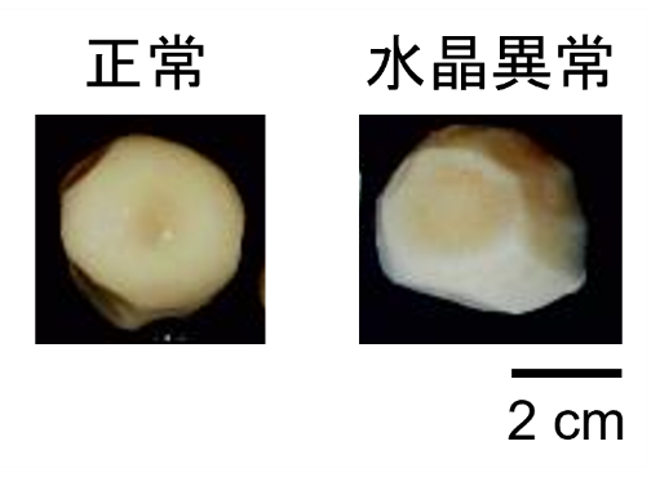
サトイモ正常芋と水晶芋の外観 類似しており、画像処理による判定は困難
<関連情報>
- https://www.ehime-u.ac.jp/data_relese/pr_20261002_cri/
- https://www.jstage.jst.go.jp/article/eaef/19/3/19_169/_article
2波長の近赤外光を用いたサトイモ水晶症異常の検出 Detection of crystalline taro abnormalities using two near-infrared (NIR) wavelengths
Keiji KONAGAYA , Taro KIMURA, Chihiro KAMIDA, Noriko TAKAHASHI
Engineering in Agriculture, Environment and Food Published: September 30, 2026
DOI:https://doi.org/10.37221/eaef.19.3_169
Abstract
Crystalline taro anomality, which arises up to 50 %, is characterized by high water content. In pouch products factory, these abnormal taros are removed manually with a lot of labor, thus a nondestructive method for its detection is highly needed. In this study, we used near-infrared spectroscopy (700–1,300 nm) to discriminate crystalline taro. A correlation analysis and multivariate analysis (PCA and SVM) were employed to select wavelength(s) and develop a discrimination model. As a result, normal and crystalline taros showed spectra with features at around 700 and 980 nm. The SVM model showed an accuracy rate of 72 %. This study is important since in factories at most 70 % of labor reduction could be expected in future.