2026-09-03 ロイヤルメルボルン工科大学(RMIT)
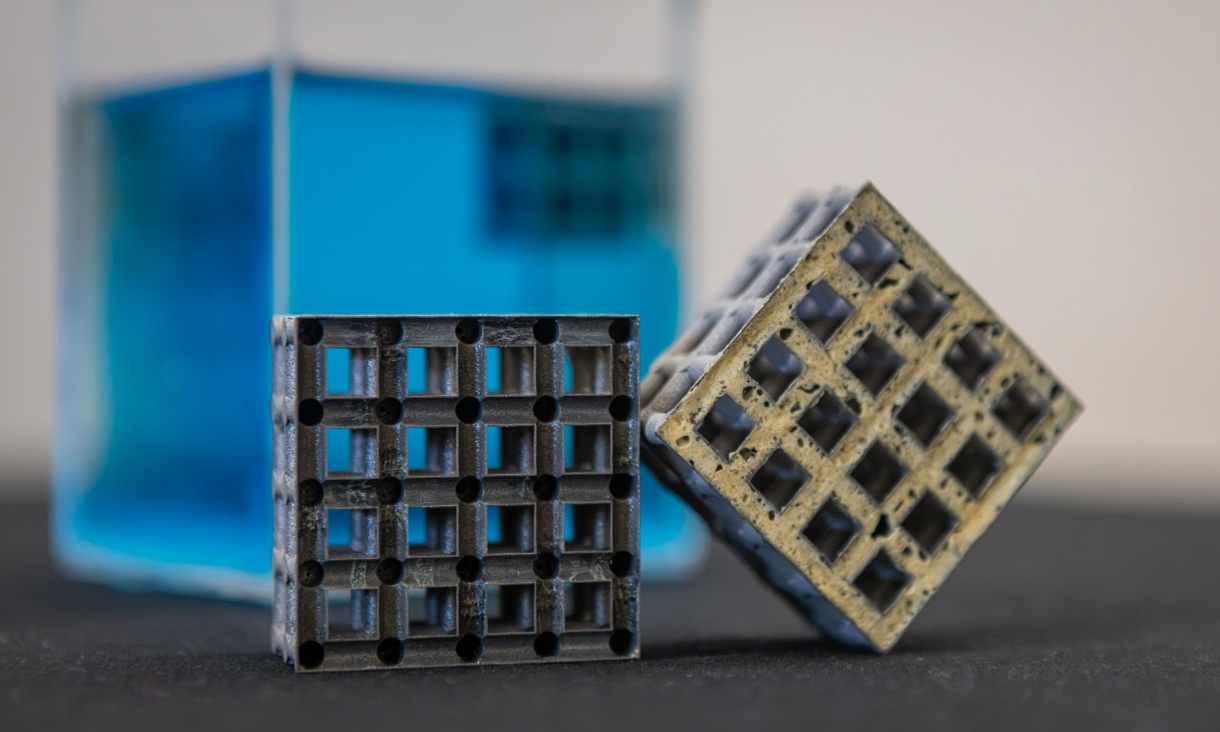
Cross sections of the titanium lattice cube showing before and after being filled with polyurethane foam for buoyancy. Credit: Sara Tan, RMIT.
<関連情報>
- https://www.rmit.edu.au/news/all-news/2026/sep/floating-titanium
- https://advanced.onlinelibrary.wiley.com/doi/10.1002/adma.74641?af=R
表面を突き破る:浮力を持つ金属-ポリマー開放セルハイブリッド格子メタマテリアル Breaking the Surface: Buoyant Metal–Polymer Open–Cell Hybrid Lattice Metamaterials
Jordan Noronha, Joey Tallon, Raad Omar, Jason Dash, Andrey Molotnikov, Martin Leary, Milan Brandt, Ma Qian
Advanced Materials Published: 28 August 2026
DOI:https://doi.org/10.1002/adma.74641
ABSTRACT
Metallic lattice metamaterials have demonstrated transformative potential across biomedical, aerospace, defense, and thermal engineering. Yet their application in buoyant marine structures has remained elusive, as their open-cell architectures inherently prevent flotation, even at densities below that of water. Here, we present the first buoyant metal–polymer open-cell hybrid lattice metamaterial. The design is guided by a novel skeletal density framework, built around an environment-independent buoyancy parameter that excludes externally accessible porosity. The resulting hybrid architecture combines Ti-6Al-4V hollow-strut lattices (HSLs)—fabricated by laser-based powder bed fusion (PBF-LB)—with expandable polyurethane (PU) foam injected into the internal channels of each strut. This architecture retains external open-cell permeability while achieving skeletal densities below 1.0 g/cm3, enabling reliable buoyancy prediction and control. Real-world applicability is demonstrated using a Ti‑6Al‑4V+PU hybrid buoy that floats stably in natural seawater. This hybrid architecture exhibits higher specific strength than conventional marine materials such as high‑density polyethylene (HDPE) and 316L stainless steel (SS316L). Seawater immersion tests further demonstrate corrosion resistance and water‑exclusion capability. Finite‑element simulations elucidate fracture initiation and predict failure modes consistent with experimental observations. Importantly, these hybrid buoyant architectures preserve flotation even after severe structural damage. This work introduces a new class of buoyant metamaterials and establishes skeletal density as a general design principle for open‑cell structures in targeted liquid media.