2026-09-02 北海道大学
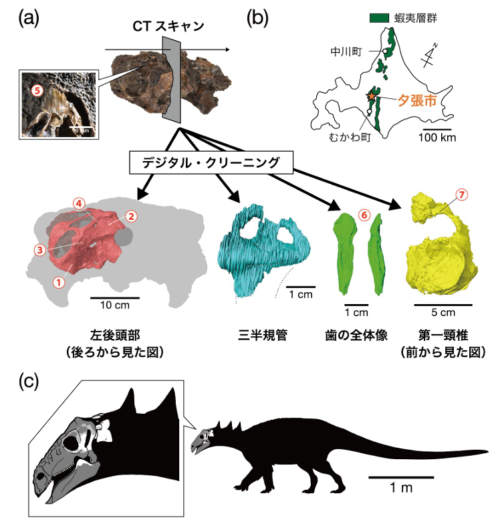
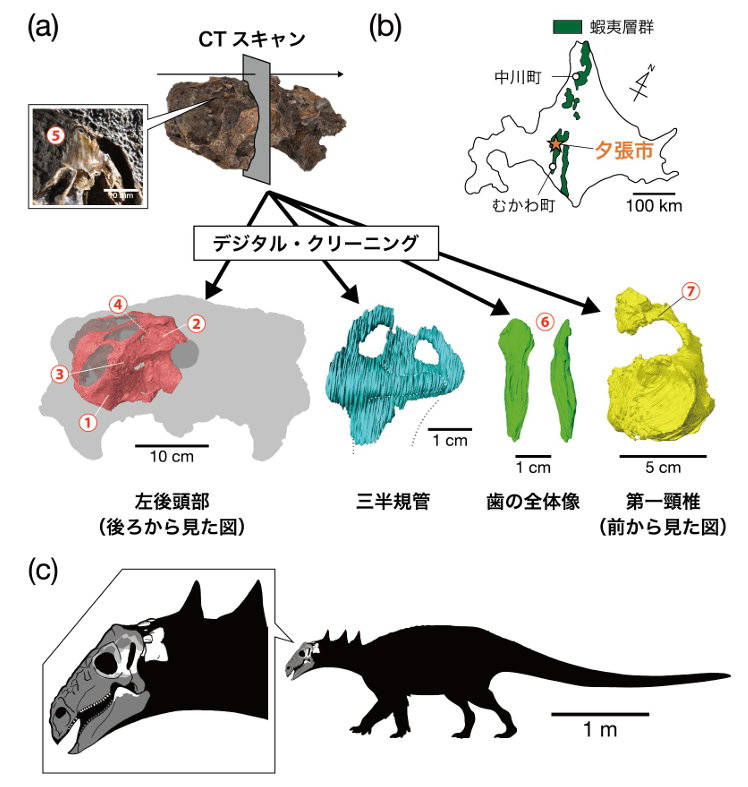
図1. ニッポノペルタのホロタイプ標本(MCM A522)と CT画像から三次元再構築した3Dモデル。
ニッポノペルタの骨格復元図(c)( ©︎増川玄哉)。
<関連情報>
- https://www.hokudai.ac.jp/news/2026/09/1-23.html
- https://www.hokudai.ac.jp/news/pdf/260902_pr2.pdf
- https://www.sciencedirect.com/science/article/abs/pii/S0195667126001667
日本の上部白亜系日陰ノ沢層から産出した新たなヨロイ竜類ノドサウルス類の恐竜が明らかにする、アジアのノドサウルス類の分散パターン A new nodosaurid ankylosaur (Dinosauria: Ornithischia) from the Upper Cretaceous Hikagenosawa Formation in Japan reveals dispersal pattern of Asian nodosaurid ankylosaurs
Shumpei Oyabu, Yoshitsugu Kobayashi, Darla K. Zelenitsky, Anthony R. Fiorillo, Manabu Kano
Cretaceous Research Available online: 21 August 2026
DOI:https://doi.org/10.1016/j.cretres.2026.106477
Highlights
- Nipponopelta yezoensis is the first ankylosaur formally named from Japan.
- The taxon is more closely related to North American nodosaurids than Asian taxa.
- Coastal environments may have played a role in interregional nodosaurid radiations.
Abstract
Nodosaurid dinosaurs are mainly known from North America and Europe, with rare occurrences in South America and Asia. A partial skull, discovered in a concretion from the upper part of the marine Hikagenosawa Formation (upper Cenomanian) in Yubari City, Hokkaido, Japan, was initially described in 2005 and identified as a nodosaurid based on its dentition and occipital bone morphology. However, its taxonomic status remained unresolved. In this study, three-dimensional CT reconstructions reveal detailed morphological features justifying the naming of a new taxon, Nipponopelta yezoensis gen. et sp. nov., the first named Japanese ankylosaur based on unique characters in the occipital region. Phylogenetic analyses indicate that Nipponopelta yezoeisis is deeply nested within derived North American and European nodosaurids and distantly related to other Asian nodosaurids. Ancestral geographic analysis suggests that Nipponopelta yezoensis and its close relatives originated in Laramidia, Appalachia, and Asia, indicating a wide ancestral area. Habitat reconstruction reveals that Nipponopelta yezoensis preferred marine-influenced environments, likely inhabiting coastal or estuarine areas. This preference for coastal environments played a significant role in its dispersal patterns across different regions.