2026-09-01 日本原子力研究開発機構,高エネルギー加速器研究機構,九州大学
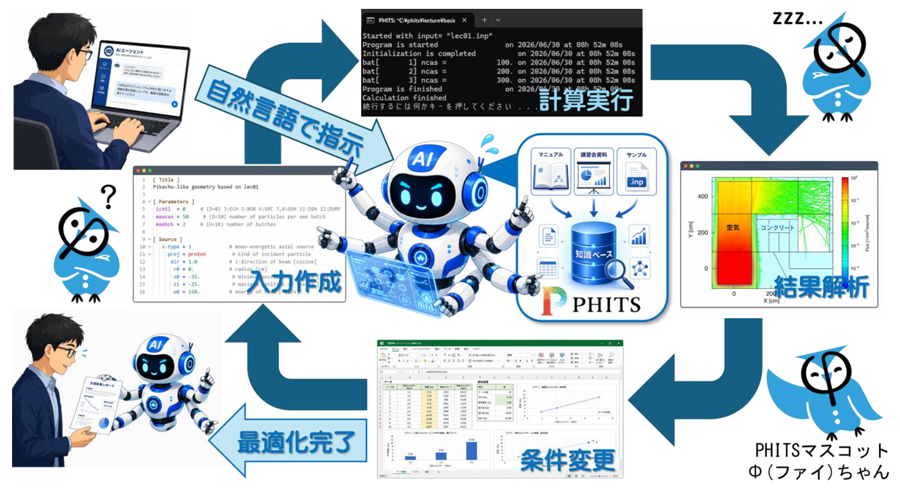
図1 本研究で実現したAIエージェントと自然言語に基づく放射線シミュレーション環境
<関連情報>
AIエージェント駆動型粒子輸送シミュレーションに向けて:PHITS向けAI支援ワークフローの実装 Toward AI-Agent-Driven Particle Transport Simulations: Implementation of AI-Assisted Workflows for PHITS
Tatsuhiko Sato, Shintaro Hashimoto, Tatsuhiko Ogawa, Takuya Furuta, Yuho Hirata, Seiki Ohnishi, Yasuhito Sakaki, Nobuhiro Shigyo
arXiv Submitted on 13 Jul 2026
DOI:https://doi.org/10.48550/arXiv.2607.11309
Abstract
Monte Carlo particle transport codes are powerful tools, but their use requires substantial knowledge of input preparation, execution, and result analysis. In this study, we present a code-side strategy for applying existing AI assistants and AI agents to PHITS. Two complementary sets of AI-ready resources were prepared from manuals, lecture materials, sample inputs, utility information, and developer-curated cautions: a bundled knowledge base for retrieval-augmented generation (RAG)-based assistants and a compact agent reference for direct use by AI agents. The knowledge base was loaded into NotebookLM to provide conversational PHITS support, while the agent reference was combined with PHITS-specific policies and execution rules to enable Codex and Claude Code to edit input files, execute calculations, inspect errors, analyze results, and assist with source-code modification and compilation. Five demonstration tasks covered input modification, repeated simulations, parameter optimization, program compilation, post-processing, and result interpretation. The results showed that AI agents could handle complex PHITS workflows when appropriate resources and rules were provided. Practical lessons included precise prompts, human verification, well-documented sample files, explicit execution policies, and command-line-accessible tools. These findings support bundling AI-ready resources with particle transport codes to enable the use of general-purpose AI tools without requiring dedicated code-specific applications.