2026-09-01 東京大学
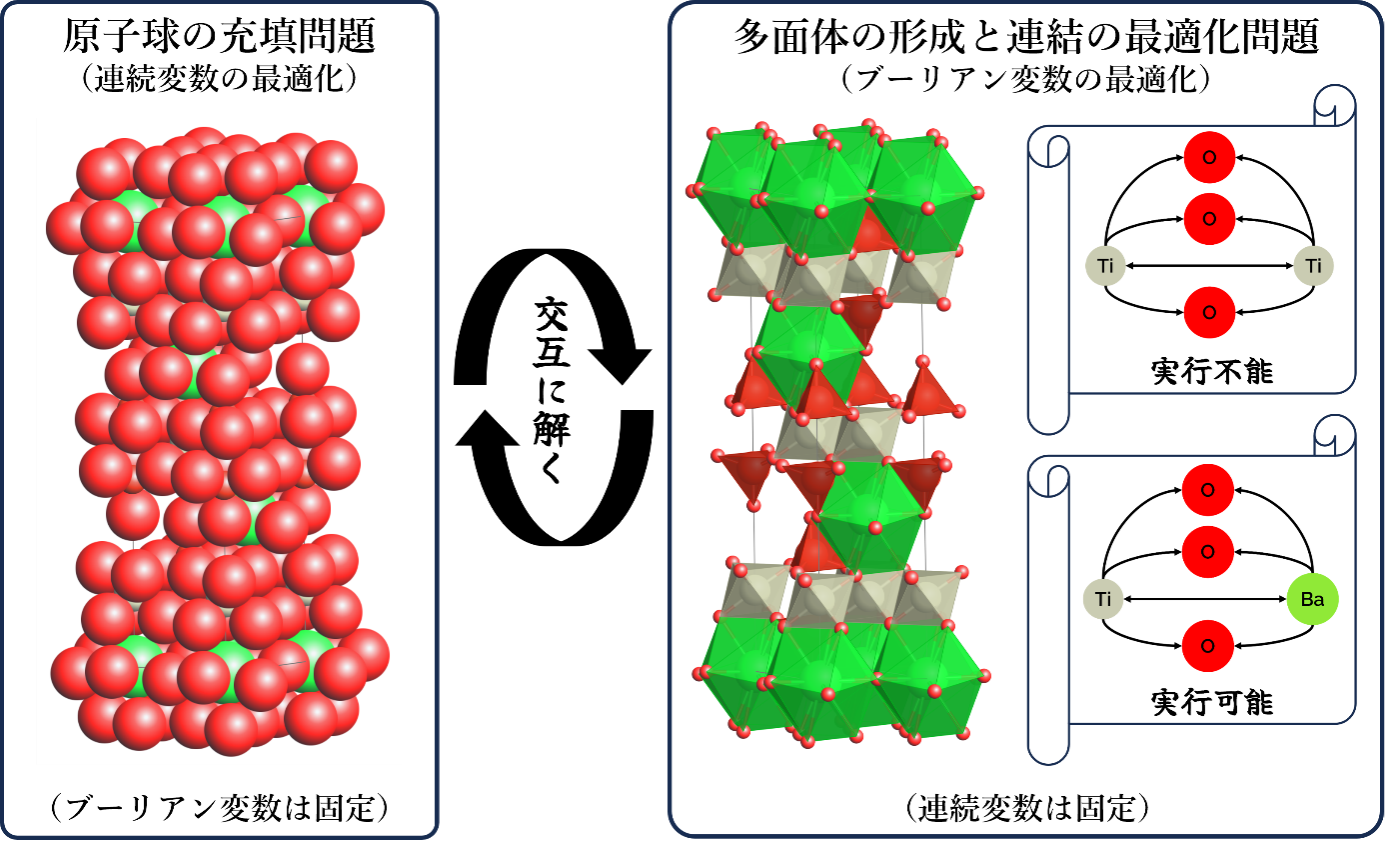
結晶構造を設計するアルゴリズムの模式図。
<関連情報>
- https://www.issp.u-tokyo.ac.jp/maincontents/news2.html?pid=31977
- https://journals.aps.org/prresearch/abstract/10.1103/6vcp-5zwf
一般化選言プログラミングによる結晶構造予測 Crystal structure prediction by generalized disjunctive programming
Ryotaro Koshoji
Physical Review Research Published: 31 August, 2026
DOI: https://doi.org/10.1103/6vcp-5zwf
Abstract
Inorganic structural chemistry leads naturally to a theory for crystal structure prediction formalized by a generalized disjunctive programming, which is formulated using continuous and Boolean variables to involve the algebraic equations, disjunctions, and logic propositions. Since the feasibilities of continuous variables change drastically depending on Boolean variables and vice versa, iterative optimization of continuous and Boolean variables efficiently transforms a randomly generated initial structure into an optimal solution. Boolean variables are introduced to elucidate the “combinatorial backbone” of the original continuous optimization problem, which corresponds to the graphs describing crystal structures with clear chemical meanings. Since many subgraphs are discovered in numerous graphs generated through structural optimizations, on-the-fly learning of the feasibilities of them accelerates the discovery of the optimal solutions. This theory enables designing a wide variety of crystal structures with small computations based on only the atomic radii and feasible coordination numbers of each atom.