2026-08-31 ペンシルベニア州立大学(Penn State)
<関連情報>
- https://www.psu.edu/news/earth-and-mineral-sciences/story/ai-streamlines-search-new-ceramics-generate-electricity
- https://www.nature.com/articles/s41467-026-74568-x
人間とAIの協働による高性能テクスチャード鉛フリー圧電セラミックスの設計と実現 Design and realization of high performance textured lead-free piezoelectric ceramics through human-AI collaboration
Aman Nanda,Debjyoti Bhattacharya,Nayeon Kang,Shankar Kunwar,Shashank Priya,Jungho Ryu,Wesley Reinhart,Michael Lanagan & Bed Poudel
Nature Communications Published:26 June 2026
DOI:https://doi.org/10.1038/s41467-026-74568-x
Abstract
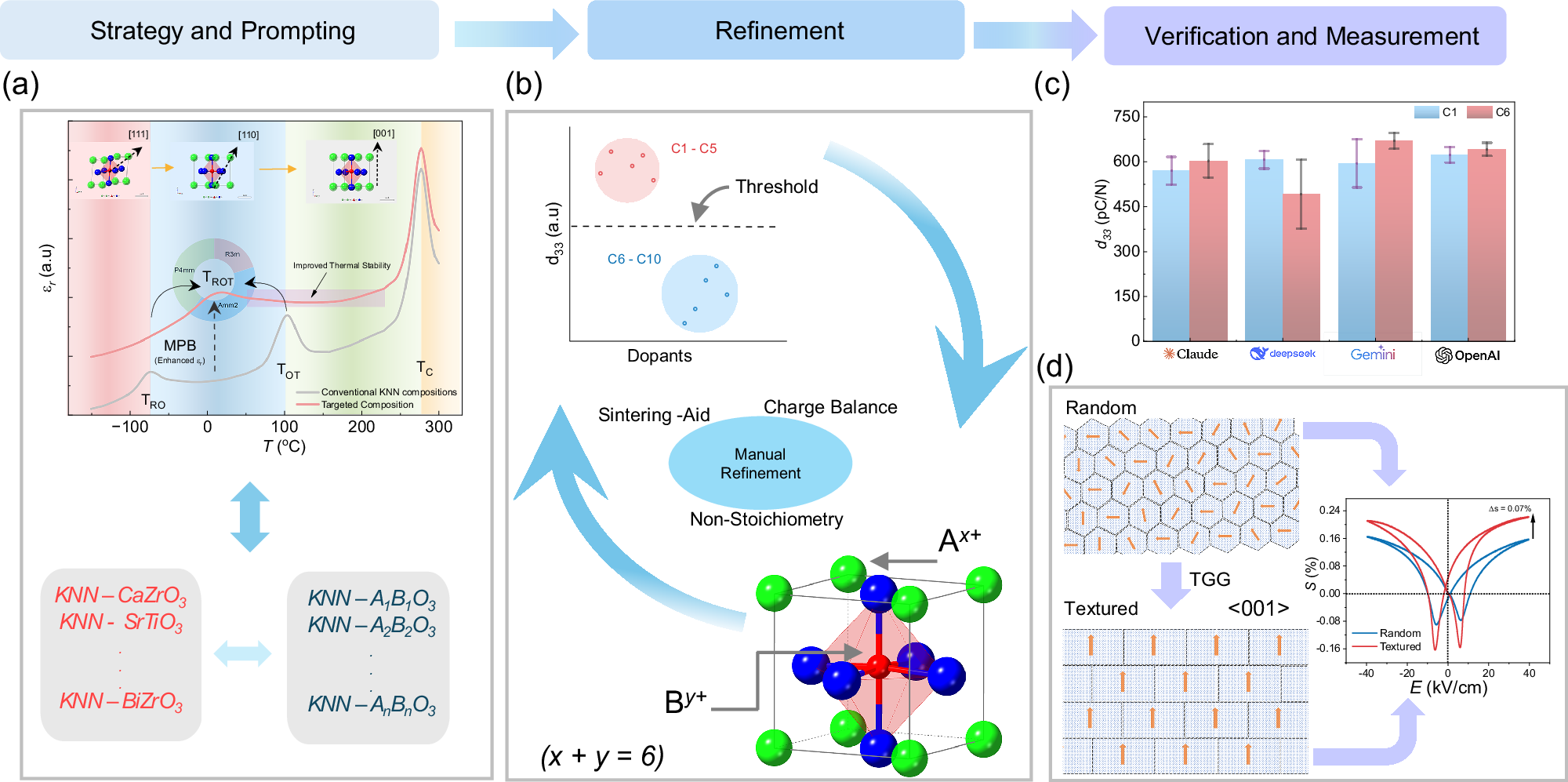
Developing multielement doped Pb-free (K,Na)NbO₃ piezoelectrics often hindered by complex doping trends and tedious trial-and-error experimentation. Here, we present a human-in-the-loop, artificial intelligence guided materials design framework that utilizes large language models to capture implicit structure-property knowledge from prior literatures and propose new compositions. Expert intervention further directs experimental realization based on materials science principles and experiential knowledge, accelerating discovery of targeted compositions. Using collaborative strategy, synthesized random composition exhibiting piezoelectric charge constant d33 of 440 − 500 pC/N which further enhanced to 600-620 pC/N through crystallographic texturing and sintering aid optimization. Despite inherently off-MPB degradation (at R.T), this composition maintained steady electromechanical coupling (kij) and d31 up to 160 oC. To validate practical relevance, a cantilever-based magneto-mechano-electric (MME) energy harvester was fabricated, delivering a power density of ~ 705μW/cm3 at the second harmonic, outperforming reported Pb-free MME designs. Here, we demonstrate an exceptional approach towards developing application-specific functional materials through the synergy of AI-driven recommender systems, human expert validation, and experimental realization.