2026-08-31 東京科学大学
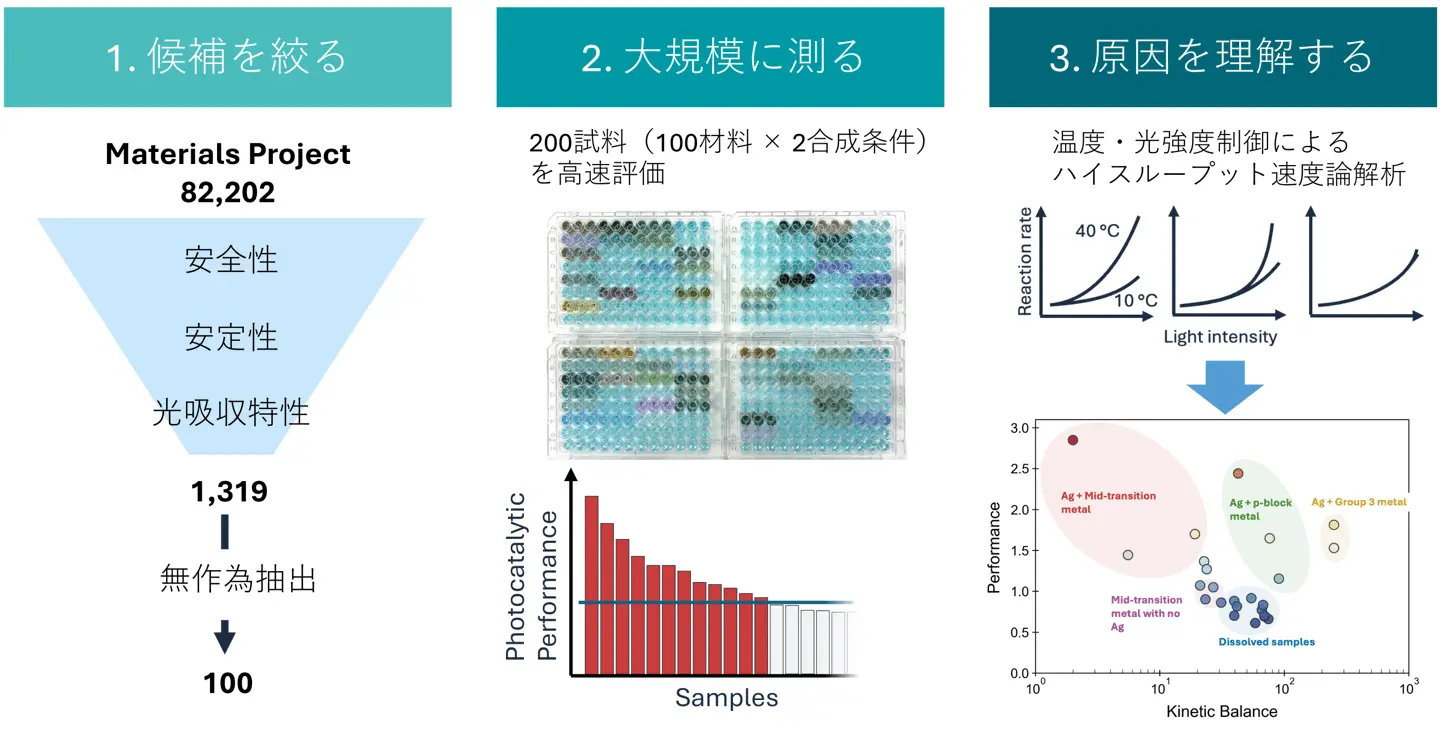
図1. 大規模探索と速度論解析を組み合わせた光触媒材料の評価フロー
<関連情報>
- https://www.isct.ac.jp/ja/news/z78imus9ubpr
- https://pubs.rsc.org/ta/article-abstract/14/50/34411/1280877/Element-dependent-charge-supply-and-charge
ハイスループット速度論解析による酸化物光触媒の電荷供給・電荷移動特性の解明
Element-dependent charge-supply and charge-transfer balance in oxide photocatalysts identified by high-throughput kinetic screening
Yohei Cho;Kyo Yanagiyama;Emi Sawade;Sunao Nakanowatari;Toru Wada;Toshiaki Taniike
Journal of Materials Chemistry A Published:21 July 2026
DOI:https://doi.org/10.1039/d6ta04494h
Photocatalyst design is commonly guided by thermodynamic requirements such as band-edge positions and light absorption, but these criteria alone do not determine catalytic performance because charge generation, transport, recombination, and interfacial charge transfer are governed by material-dependent kinetics. Establishing kinetic design principles therefore requires not only large and diverse material libraries, but also throughput-compatible experiments that extract kinetic information across many compositions. Here, we develop a high-throughput kinetic screening strategy for oxide photocatalysts by combining broad materials exploration with temperature- and light-intensity-dependent photocatalytic evaluation. From 82 202 oxygen-containing candidates in the Materials Project, we narrowed the candidate space using safety, synthesizability, and bandgap criteria, randomly selected 100 compositions, and synthesized them at 400 and 1000 °C. Initial screening identified sparse but promising activity among Ag- and Mn-containing oxides. To convert this activity screening into kinetic information, selected active materials were evaluated under controlled temperature and light intensity, enabling classification of their charge-supply and charge-transfer balance using the onset intensity for temperature dependence. The resulting kinetic map shows that elemental identity systematically modulates this balance: Ag-containing oxides with mid-transition metals such as Mn and V tend to exhibit strong charge-supply characteristics, those containing p-block elements such as Al and Bi occupy an intermediate region, and those containing group 3 elements such as Sc and Y are shifted toward charge-supply-limited behavior. These results demonstrate that high-throughput photocatalytic evaluation can be extended beyond empirical activity screening to provide element-dependent kinetic design guidelines for oxide photocatalysts.