2026-09-29 青山学院大学
<関連情報>
- https://www.aoyama.ac.jp/center104/2026/news_20260929_01
- https://pubs.rsc.org/qi/article-abstract/doi/10.1039/d6qi01365a/1360155/Rational-design-of-lanthanide-triboluminescence-by
配位子三重項状態変調と異方性結晶破壊によるランタニド摩擦発光の合理的設計
Rational design of lanthanide triboluminescence by ligand triplet-state modulation and anisotropic crystal fracture
Reo Ohno;Daisuke Hayauchi;Kota Chikaraishi;Haruki Takiguchi;Hitomi Ohmagari;Shogo Kawaguchi;Kenta Goto;Daiki Tauchi;Masashi Hasegawa;Miki Hasegawa
Inorganic Chemistry Frontiers Published:12 September 2026
DOI:https://doi.org/10.1039/d6qi01365a
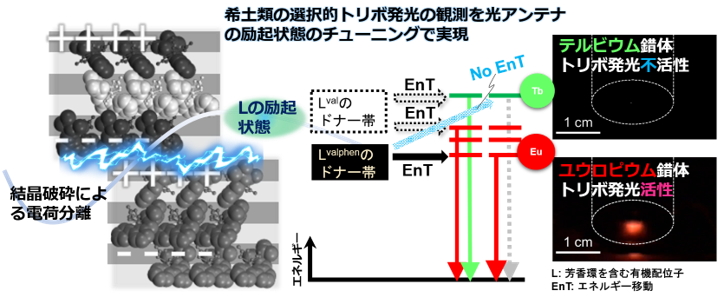
Elucidating the mechanistic basis of triboluminescence (TL) in lanthanide (Ln) complexes—particularly whether mechanical stimuli excite the coordinated ligand, which subsequently sensitizes Ln3+via the photo-antenna effect—remains a central challenge in the field. To address this, we synthesized novel chiral lanthanide complexes, LnLvalphen (Ln = Eu, Tb and Gd), in which the 2,2′-bipyridine scaffold of the parent LnLval framework is replaced by a 1,10-phenanthroline moiety, systematically lowering the ligand triplet excited state from ca. 22 200 cm−1 to ca. 19 200 cm−1. This modification selectively enables energy transfer to Eu3+ (5D0: 17 200 cm−1) while precluding sensitization of Tb3+ (5D4: 20 400 cm−1)—a selectivity that mirrors the PL behavior and is fully consistent with ligand-mediated excitation. S-EuLvalphen crystallizes in the noncentrosymmetric space group P31, adopting an anisotropic lamellar structure that undergoes preferential interlamellar cleavage under mechanical stimulation. As-synthesized S-EuLvalphen exhibits red Eu3+-centered TL, whereas the racemic form shows none. Atmospheric gas exclusion experiments and Ln-series TL measurements collectively rule out N2 discharge and direct Ln3+ excitation. Taken together, these results provide direct evidence that mechanical cleavage of the lamellar structure excites the ligand, followed by energy transfer to Eu3+via the photo-antenna effect, establishing ligand triplet excited state engineering as a rational strategy for controlling TL in chiral Ln complexes.