2026-08-18 中国科学院(CAS)
<関連情報>
- https://english.cas.cn/newsroom/research-news/202608/t20260818_1188025.shtml
- https://link.springer.com/article/10.1007/s11104-026-08940-7
熱帯マメ科植物は、土壌リン制限条件下では、同種植物よりも異種植物と混植した方がより有益である Tropical legume plants benefit more when grown with interspecific plants than intraspecific under soil phosphorus-limited conditions
Jan Sher,Yun-Bing Zhang,Ghulam Mujtaba Shah,Stephen P. Bonser & Jiao-Lin Zhang
Plant and Soil Published:04 August 2026
DOI:https://doi.org/10.1007/s11104-026-08940-7
Abstract
Aims
Plant–plant interactions shape community structure and ecosystem functioning, and outcomes can shift between facilitation and competition depending on neighbor identity and soil fertility. However, responses of tropical legume species to intra- and interspecific neighbors under phosphorus (P)-limited conditions remain poorly understood. Here, we examine how tropical legumes grow and acquire resources under different neighbor identities across contrasting P levels.
Methods
Seedlings of four tropical legumes (Crotalaria assamica, C. pallida, Flemingia macrophylla, and Ototropis multiflora) were grown for seven months in a glasshouse under three P levels (low: 10 mg/kg, medium: 20 mg/kg, high: 50 mg/kg) and subjected to intraspecific, interspecific, and no-competition treatments. Above and belowground traits were measured using standard methods.
Results
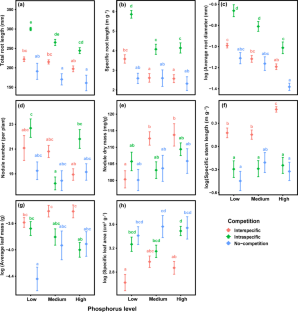
Plants with interspecific neighbors produced greater aboveground and total biomass than intraspecific and no-competition treatments. In contrast, intraspecific interactions increased belowground biomass and resource-acquisition traits. Relative neighbor effect (RNE) varied among species and P levels. C. pallida shifted from facilitation at low P to competition at high P, while C. assamica showed consistent facilitation. F. macrophylla and O. multiflora responded weakly. Interspecific interactions increased biomass gains (1.27–1.55 g), whereas intraspecific interactions resulted in near-zero or negative gains (−0.17 g in C. pallida). Under low P, C. assamica and F. macrophylla lost biomass (−1.75 and −0.74 g). Interspecific interactions enhanced leaf nutrients and antioxidant activity, improving nutrient uptake and stress tolerance.
Conclusion
P availability and neighboring plant identity jointly determine plant performance in tropical legumes, with interspecific interactions promoting growth and stress tolerance, especially under P limitation.