2026-08-04 中国科学院(CAS)
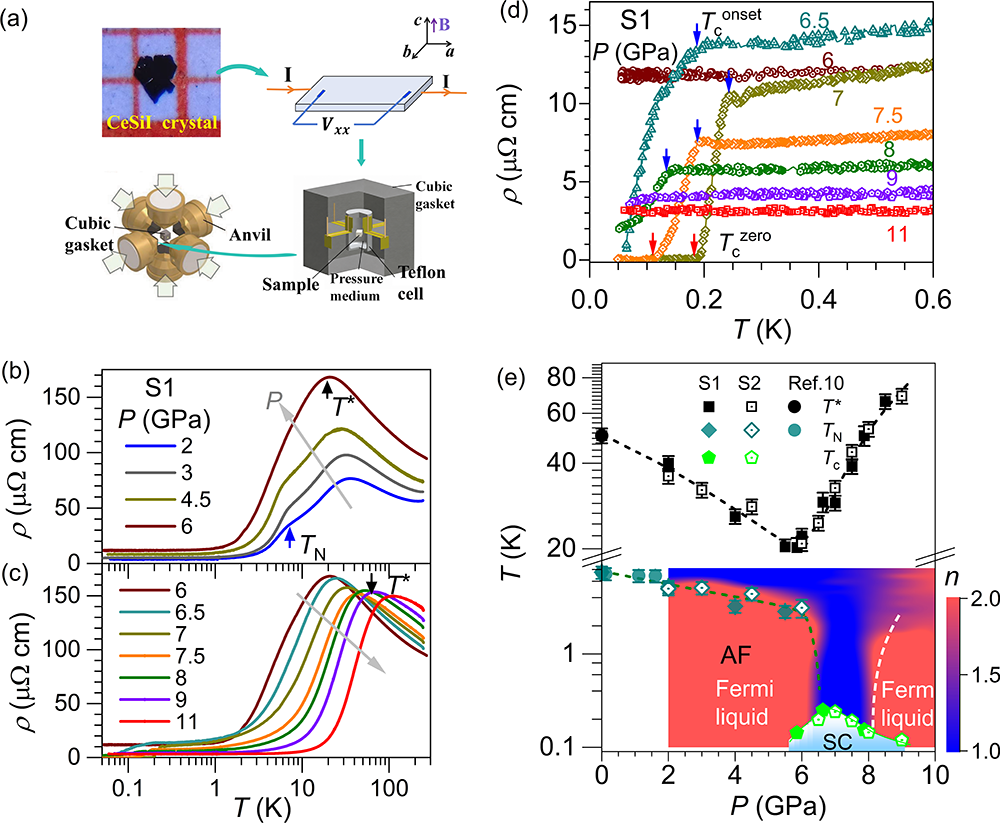
High-pressure transport measurements and temperature-pressure phase diagram of the vdW heavy-fermion meta CeSiI. Increasing pressure suppresses antiferromagnetic order, induces superconductivity near the quantum critical point, and leads to an unusual V-shaped evolution of the Kondo coherence temperature. (Image by IOP)
<関連情報>
- https://english.cas.cn/newsroom/research-news/202608/t20260804_1186882.shtml
- https://www.nature.com/articles/s41567-026-03392-3
ファンデルワールス重フェルミオン金属における圧力下での超伝導 Superconductivity under pressure in a van der Waals heavy-fermion metal
Tong Shi,Wenhao Li,Qingxin Dong,Pengtao Yang,Hanming Ma,Zhaoming Tian,Ningning Wang,Jianping Sun,Yoshiya Uwatoko,Yi-feng Yang,Bosen Wang,Hechang Lei & Jinguang Cheng
Nature Physics Published:28 July 2026
DOI:https://doi.org/10.1038/s41567-026-03392-3
Abstract
CeSiI is a van der Waals heavy-fermion metal featuring a long-range antiferromagnetic order and Kondo coherence. The phase diagram that details the evolutions of the transition temperatures of those two orders as a function of external tuning parameters such as pressure is crucial for understanding strong electron interactions in heavy-fermion systems. Here we experimentally demonstrate the phase diagram of CeSiI. The critical temperature of the Kondo coherent state exhibits a V-shaped, non-monotonic dependence on pressure. Upon suppression of the antiferromagnetic order, a superconducting dome emerges with a maximum transition temperature of about 240 mK and the coherence temperature reaches its minimum. The close proximity of superconductivity to antiferromagnetic instability, together with a large upper critical field, suggests an unconventional pairing mechanism in CeSiI. Normal-state transport measurements further provide evidence for quantum criticality, as manifested by non-Fermi-liquid behaviour and divergence of the effective electron mass. Our findings support CeSiI as a heavy-fermion superconductor and reveal an unconventional nature for its Kondo coherence at ambient pressure, thus offering a platform for exploring the interplay among strong electron correlations, Kondo hybridization, magnetism and unconventional superconductivity in two-dimensional heavy-fermion systems.