2026-07-21 ロイヤルメルボルン工科大学(RMIT)
<関連情報>
- https://www.rmit.edu.au/news/all-news/2026/jul/green-hydrogen-innovation
- https://www.sciencedirect.com/science/article/pii/S0926337326005084
ナノ閉じ込めされたNi単原子Ni–O–Ti原子非対称サイトによる高効率かつ安定した光触媒水素発生 Nanoconfined Ni single-atom Ni–O–Ti atomic asymmetric sites for highly efficient and stable photocatalytic hydrogen evolution
Bowen Li, Siyuan He, Jitao Li, Ting Sun, Chunhua Zhang, Hao Zhang, Lina Xiao, Ravichandar Babarao, Li Gao, Yichao Wang, Derek Hao
Applied Catalysis B: Environment and Energy Available online: 30 April 2026
DOI:https://doi.org/10.1016/j.apcatb.2026.126888

Highlights
- Asymmetric Ni–O–Ti single-atom sites enable efficient H2 evolution.
- Oxygen-defect nanoconfinement boosts charge separation.
- 80-time higher activity than pristine TiO2 photocatalyst.
Abstract
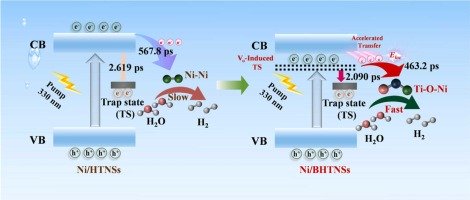
Photocatalytic hydrogen production is a promising route toward sustainable energy conversion. However, the overall efficiency remains limited by severe charge recombination and low carrier utilization. Herein, asymmetric interfacial Ni–O–Ti sites were constructed via oxygen-defect-induced nanoconfinement, forming oxygen bridges between hollow TiO2 nanospheres (HTNSs) and single–atom Ni species. The hollow TiO2 nanosphere catalyst with oxygen defects and Ni single atoms (Ni/BHTNSs) exhibited a high hydrogen evolution activity of 816 μmol·h–1, which is more than 80 times higher than that of pure TiO2. Experimental and theoretical analyses demonstrated that the oxygen defects and hollow structure accelerated the charge carrier separation and transfer, which significantly boosted the hydrogen generation. Compared with symmetric Ni–O–Ni coordination, the asymmetric Ni–O–Ti configuration shortens the Ni–O bond length, enabling more favorable linear H⁺ adsorption and electron accumulation while lowering the energy barrier for H2 formation. These effects collectively accelerate hydrogen evolution kinetics. This work presents an atomic-level asymmetric site design coupled with nanoconfinement engineering, offering a robust strategy for efficient and stable photocatalytic water splitting.