2026-07-14 中国科学院(CAS)
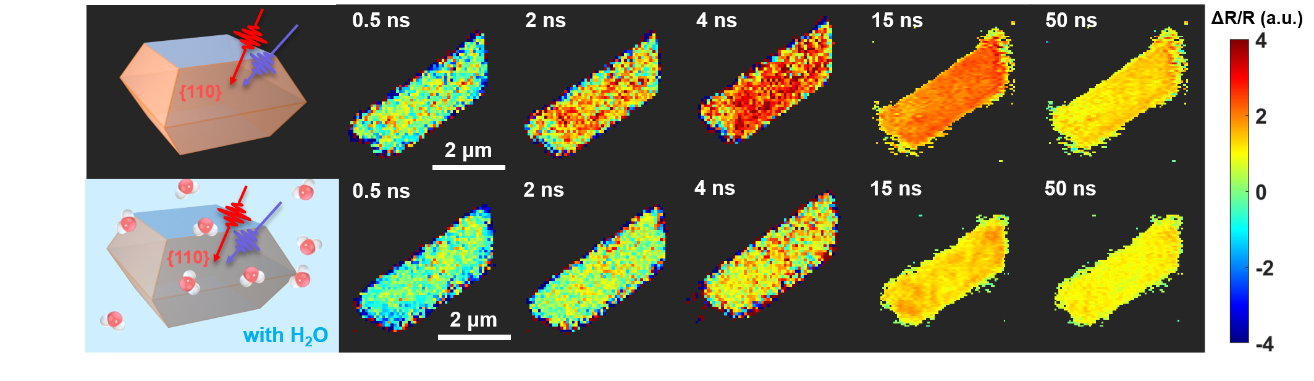
Schematic illustration of the proposed photogenerated hole evolution pathway involving three steps: ultrafast charge separation, hole trapping, and rapid interfacial transfer (Image by SUN Fengke)
<関連情報>
- https://english.cas.cn/newsroom/research-news/202607/t20260714_1178233.shtml
- https://academic.oup.com/nsr/advance-article/doi/10.1093/nsr/nwag379/8711408
光触媒における電荷分離から界面移動までの光生成正孔の進化を解明する Unraveling the evolution of photogenerated holes from charge separation to interfacial transfer in photocatalysis
Fengke Sun,Yue Zhao,Xianchang Yan,Panwang Zhou,Can Li,Rengui Li,Shengye Jin,Wenming Tian
National Science Review Published:18 June 2026
DOI:https://doi.org/10.1093/nsr/nwag379
Abstract
A photocatalytic process involves the intricate integration of complex photophysical and photochemical events that occur at nanoscale interfaces and evolve over femtoseconds to second scales. However, directly tracking the nanoscale carrier dynamics of a single photocatalyst crystal under the reaction conditions is essential but remains challenging. Here, we employed in-situ transient reflection microscopy to spatiotemporally resolve the evolution of photogenerated carriers in facet-engineered bismuth vanadate (BiVO4) photocatalyst. It is revealed that photogenerated holes undergo three sequential steps: initial ultrafast charge separation (~5 ps), hole trapping (~1.5 ns), and trap states‐mediated interfacial transfer to pre-adsorbed H2O on the surface (~19 ps). Crucially, trap states associated with oxygen lattice sites act as nanoscale relay sites that enable rapid hole injection into pre-adsorbed H2O, whereas direct valence-band hole injection is negligible. These findings provide a comprehensive mechanistic picture of photogenerated carrier dynamics across the entire photocatalytic process, directly linking nanostructure to interfacial chemistry and revealing trap states as critical mediators of efficient interfacial charge transfer.