2026-07-08 産業技術総合研究所
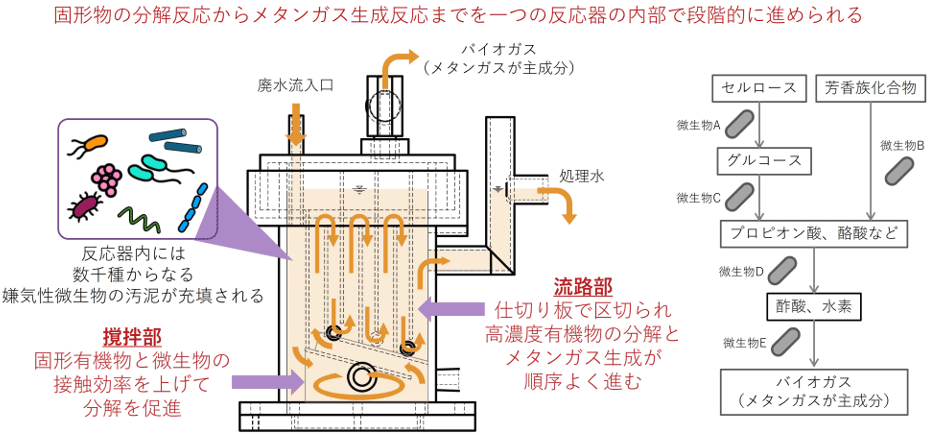
図1 開発したABCS反応器の構造と反応器内で進行する微生物反応の模式図
※原論文の図を引用・改変したものを使用しています。
<関連情報>
- https://www.aist.go.jp/aist_j/press_release/pr2026/pr20260708/pr20260708.html
- https://www.sciencedirect.com/science/article/pii/S2213343726028605
合成高濃度廃水と固体有機廃棄物の共消化のための嫌気性バッフル付き連続攪拌(ABCS)リアクターの開発 Development of an anaerobic baffled continuous stirring (ABCS) reactor for co-digestion of synthetic high-strength wastewater and solid organic waste
Rino Isshiki, Masayoshi Yamada, Tomo Aoyagi, Tomoyuki Hori, Masahito Yamauchi, Takashi Narihiro, Kyohei Kuroda
Journal of Environmental Chemical Engineering
Available online 29 June 2026
DOI:https://doi.org/10.1016/j.jece.2026.123885
Highlights
- ABCS reactor enables high-rate co-digestion of solid organic waste and wastewater.
- Integrated stirring and baffled stages enhance solubilization and methanogenesis.
- ABCS reactor achieved a 1.62-fold higher methane production rate than ABR.
- Solid accumulation was not observed in ABCS reactor.
- Putative cellulose-degrading bacteria were more abundant in ABCS reactor.
Abstract
To establish high-rate treatment process for co-digestion of high-strength wastewater and solid organic waste, we developed a novel bioreactor system: an anaerobic baffled continuous stirring (ABCS) reactor. This reactor integrates continuous stirring stage with baffled compartments. The first continuously stirred stage promotes solubilization of organic compounds and the second baffled compartment stage contained high concentration of anaerobic sludge. This design enables immediate methanogenesis of solubilized organic matter. In this study, we compared the reactor performance of the ABCS reactor with that of a conventional anaerobic baffled reactor (ABR) during continuous operation for over 100 days, treating identical wastewater derived from a bio-manufacturing process. The ABCS reactor achieved high methane production rates of 2.51 kgCOD m–3 d–1, representing a 1.62-fold increase compared to the ABR. Furthermore, cellulose in the wastewater accumulated in the upstream baffled compartments of ABR, whereas no noticeable accumulation was observed in the ABCS reactor. In addition, the abundance of putative cellulose degraders was much higher in the ABCS reactor than in the ABR, suggesting that these bacteria may contribute to the mineralization of solid organic waste in the baffled compartment. These results demonstrate the successful development of a novel and high-rate treatment system for co-digestion of high-strength wastewater and solid organic waste.