20206-07-02 東北大学
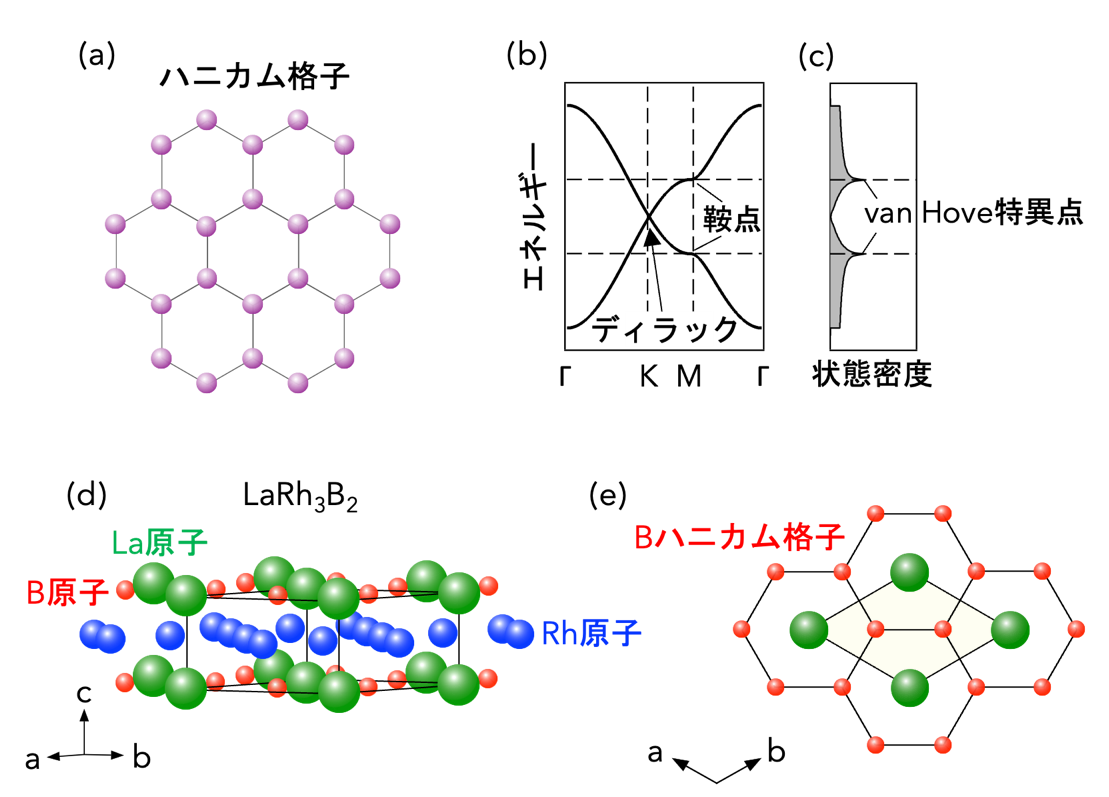
図1.
(a)原子が蜂の巣状に配列したハニカム格子。
(b)ハニカム格子のエネルギーバンド。ディラック電子や鞍点といった特徴的構造を示す。
(c)(b)に対応する、エネルギーと状態密度の関係。鞍点のあるエネルギーに状態密度の異常=van Hove特異点が現れる。
(d)LaRh3B2の結晶構造。La/B層とRh層が交互に積み重なる構造を持つ。
(e)(d)からLa/B層を抜き出したもの。B原子のハニカム格子が見られる。
<関連情報>
- https://www.tohoku.ac.jp/japanese/2026/07/press20260702-02-boron.html
- https://www.science.org/doi/10.1126/sciadv.aee3116
強相関2次元ハニカムホウ素の実現 Realization of strongly correlated 2D honeycomb boron
Takemi Kato, Tomonori Nakamura, Kosuke Nakayama, Takumi Osumi, […] , and Takafumi Sato
Science Advances Published:1 Jul 2026
DOI:https://doi.org/10.1126/sciadv.aee3116
Abstract
Borophene, a two-dimensional (2D) boron sheet, has recently gained considerable attention as a postgraphene material owing to its unique properties, such as intrinsic metallic character, lightest element monolayer structure, and high-frequency phonons. These features, together with its theoretically predicted high density of states, make borophene an excellent platform for investigating various quantum phenomena. However, the realization of emergent phenomena is hindered by fabrication challenges and inherently weak electronic correlations within the s and p electron system. Here, we demonstrate a strongly correlated 2D electronic state derived from a honeycomb boron lattice exposed at the surface of ternary boride LaRh3B2. Using angle-resolved photoemission spectroscopy, we uncover the extended saddle-point van Hove singularity near the Fermi level, which is linked to the substantial lattice expansion and many-body interaction. Moreover, scanning tunneling microscopy reveals the electronic nematicity, which likely originates from the saddle-point instability. Our findings open a pathway to exploring the exotic correlated phenomena in boron-based 2D systems.