2026-06-30 北海道大学
水中光結晶合成法(SPsC)と光誘起静電容量性―導電性遷移の光電気化学
<関連情報>
- https://www.hokudai.ac.jp/news/2026/06/–13.html
- https://www.sciencedirect.com/science/article/pii/S2590123026025533
光電気化学エネルギー増強につながる銅ドープタングステン酸の光誘起静電容量―導電性遷移 Photoinduced capacitive-to-conductive transition in Cu-doped tungsten oxide hydrates toward enhanced photoelectrochemical energy conversion
Lihua Zhang, Kira Yamauchi, Kohei Fukuroi, Hsueh-I Lin, Seiichi Watanabe
Results in Engineering Available online: 12 June 2026
DOI:https://doi.org/10.1016/j.rineng.2026.111527
Highlights
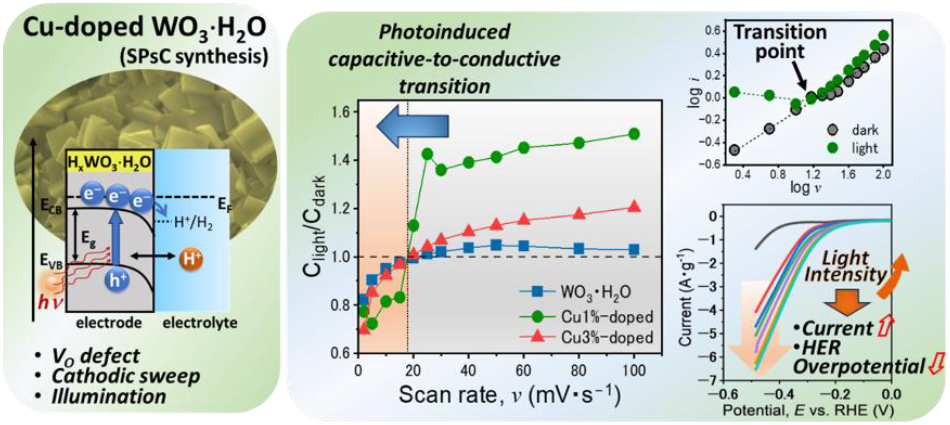
- Photoinduced capacitive-to-conductive transition in Cu-doped WO₃·H₂O.
- Defect-engineered Cu-doped WO₃·H₂O enhances visible–NIR photoresponse.
- Proton intercalation drives semiconductor-to-metallic conversion.
- Linear and nonlinear light-enhanced domains were identified.
- Illumination increases carrier density to lower the HER overpotential.
Abstract
A photoinduced capacitive-to-conductive (C2C) transition is reported in Cu-doped WO3·H2O during the electrochemical reactions, enabling light-controlled modulation of electronic transport and hydrogen evolution reaction (HER) activity. This transition occurs under cathodic potentials and is governed by Cu-doping level, illumination, and potential scan rate. To investigate this phenomenon, WO3·H2O (tungstite) and Cu-doped WO3·H2O nanoplates were synthesized using the submerged photosynthesis of crystallites (SPsC) method, an environmentally benign, light-driven aqueous approach. Electrochemical and photoelectrochemical analyses were performed using cyclic voltammetry, Mott–Schottky, and linear sweep voltammetry. These results reveal that under slow scan rate and cathodic potentials, proton intercalation leads to HxWO3·H2O formation, triggering a C2C transition due to a semiconductor-to-metal conversion, while simultaneously promoting hydrogen evolution. Upon illumination, a rapid and reversible increase in cathodic current is observed, reflecting enhanced carrier density and electronic conductivity. Both the carrier density and photocurrent increase linearly with light intensity, while the HER overpotential decreases correspondingly. Cu doping narrows the bandgap and introduces oxygen-vacancy-related sub-band states, thereby improving light absorption and charge transport. These findings provide fundamental insights into light- and defect-mediated conductivity switching and highlight WO3·H2O as a promising photoresponsive material for energy storage and photoelectrocatalysis.