
2026-06-30 パシフィック・ノースウェスト国立研究所(PNNL)
<関連情報>
- https://www.pnnl.gov/publications/mixpi-path-integral-software-large-systems
- https://pubs.aip.org/aip/jcp/article/164/21/212501/3393752/MixPI-Mixed-time-slicing-path-integral-software
MixPI:量子化分子動力学シミュレーションのための混合時間スライス経路積分ソフトウェア
MixPI: Mixed-time slicing path integral software for quantized molecular dynamics simulations
Britta A. Johnson;Siyu Bu;Christopher J. Mundy;Nandini Ananth
The Journal of Chemical Physics Published:June 05 2026
DOI:https://doi.org/10.1063/5.0327460
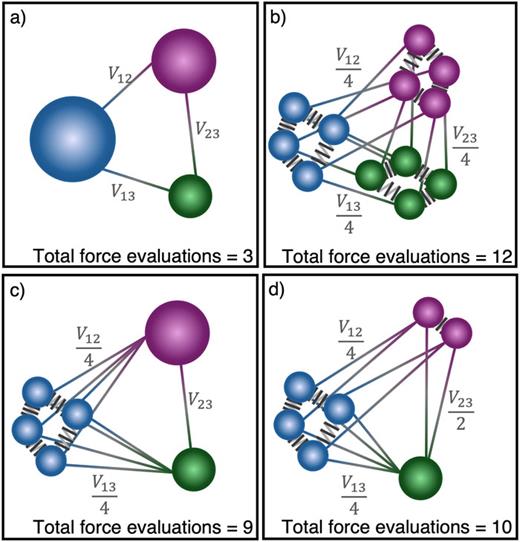
We introduce the MixPI software to implement path integral molecular dynamics (PIMD) simulations for the study of condensed phase systems where nuclear quantum effects (NQEs) are important. In contrast to existing PIMD simulation software, MixPI enables the implementation of mixed quantum–classical path integral simulations where only a subset of system degrees of freedom (dofs) are treated quantum mechanically in an extended phase space while the remaining dofs are described classically. We expect this software to be particularly useful for simulations of electron and proton transfer in condensed phase systems, as well as for the study of biological and material systems where only a handful of dofs contribute significantly to the observed NQEs. We demonstrate the use of MixPI in two different systems. The first is a simple water model where we implement a set of mixed quantum–classical simulations to compute average energy and radial distribution functions. We use these simulations to benchmark the effectiveness of MixPI and to demonstrate how it enables systematic investigation into the origin of observed NQEs. We then compute radial distribution functions for a system where MixPI is essential: a solvated metal (M2+) cation described using an explicit quantized electron localized on an M3+ ion in water.

