2026-06-22 リンショーピング大学
<関連情報>
- https://liu.se/en/news-item/har-kan-naturvard-gora-storst-skillnad-for-att-radda-hotade-arter
- https://link.springer.com/article/10.1007/s10980-026-02373-4
生息地の閾値に基づいて、スウェーデンの半自然草地と老齢オーク(Quercus robur )の機能的景観を特定する Identifying functional landscapes in Sweden for semi-natural grasslands and old-growth oaks (Quercus robur) based on habitat thresholds
Karl-Olof Bergman,Leif Andersson,Markus Franzén,Victor Johansson & Lars Westerberg
Landscape Ecology Published:22 May 2026
DOI:https://doi.org/10.1007/s10980-026-02373-4
Abstract
Context
The loss of biodiversity due to habitat destruction has been identified as a critical global issue. There is an urgent need for landscape-based guidelines for critical levels of habitat amount in conservation work.
Objectives
The aims were to identify habitat amount thresholds for species associated with old oaks and semi-natural grasslands, and to map functional areas and areas with habitat mismatch to guide conservation and restoration planning.
Methods
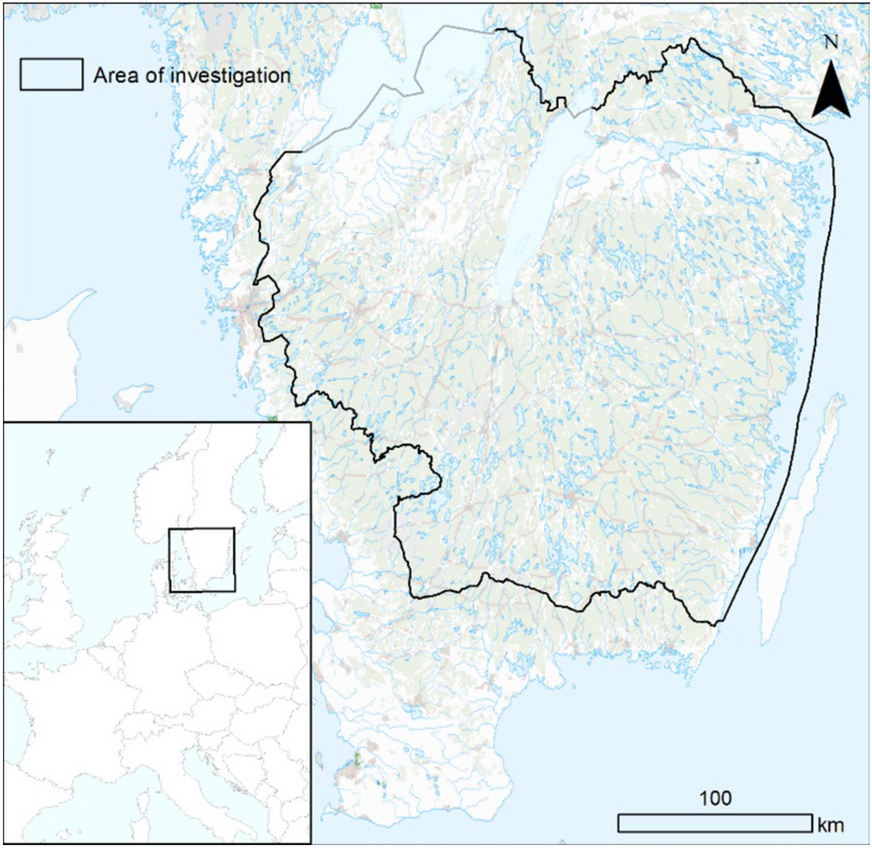
We used spatial data on the distribution of old oaks (Quercus robur) and semi-natural grasslands in southern Sweden, combined with an extensive dataset of occurrence records for species associated with these habitats. Presence and absence of 102 species in grid cells in relation to habitat amount were analysed using binomial GLMs weighted by survey effort.
Results
A total of 86 species showed a significant positive relationship between occurrence and habitat amount and these relationships were used to identify habitat thresholds. Species-specific threshold values within each habitat type ranged from low to high, showing considerable variation in habitat requirements. The mapping of functional areas showed clear patterns in the study area with large differences between regions. However, there were also large regions showing a habitat mismatch, i.e., occurrence of species in areas with habitat amounts below the estimated thresholds suggesting potential extinction debts. Our analysis shows that by prioritising habitat restoration sites it is possible to make them fully functional in the future, offering tools for cost-effective nature conservation.
Conclusions
The approach here, using extensive, partly citizen science data and relatively simple models to provide conservation practitioners and planners with decision support maps, can be a useful tool to tackle biodiversity loss. However, threshold values should be interpreted as minimum targets, and complementary consideration of habitat connectivity and climate change is recommended.