2026-06-24 東北大学
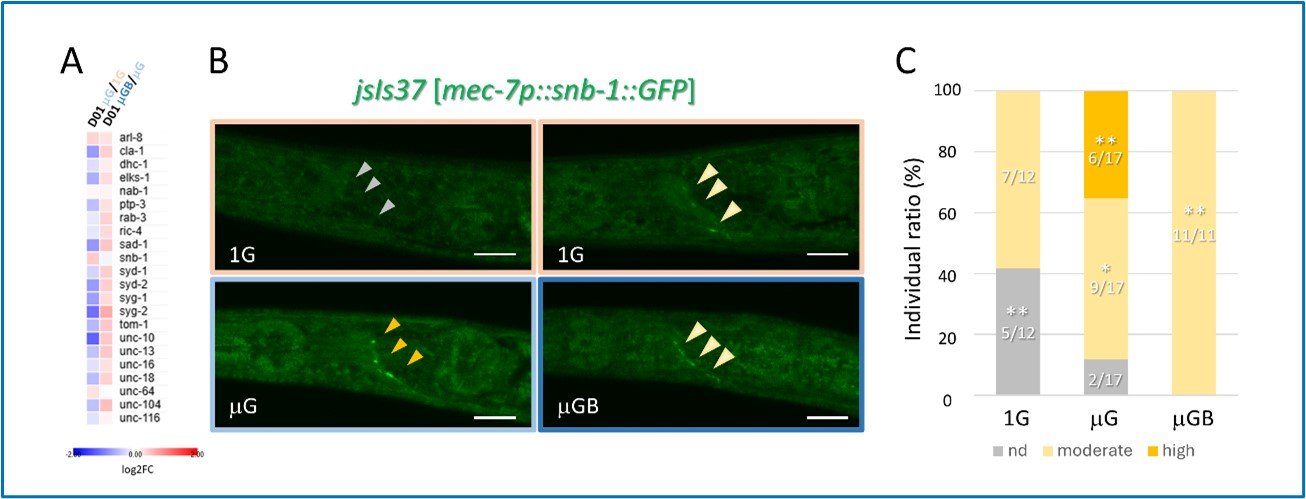
図1. 宇宙無重力下で育成した線虫における神経シナプス伝達活動
<関連情報>
- https://www.tohoku.ac.jp/japanese/2026/06/press20260624-01-elegans.html
- https://faseb.onlinelibrary.wiley.com/doi/10.1096/fj.202600867RR
宇宙微小重力下での機械的触覚刺激の減少は、シナプス伝達に影響を与え、線虫(Caenorhabditis elegans)の神経筋老化に寄与する Reduced Mechanical Tactile Stimulation Under Space Microgravity Affects Synaptic Signaling and Contributes to Neuromuscular Aging in Caenorhabditis elegans
Atsushi Higashitani, Je-Hyun Moon, Jong-In Hwang, Nahoko Higashitani, Toko Hashizume, Ahmad Aisha Abu, Kazuki Ooizumi, Ibuki Sazuka, Yoshimitsu Hashizume …
The FASEB Journal Published: 16 June 2026
DOI:https://doi.org/10.1096/fj.202600867RR
ABSTRACT
Although space travel is becoming more accessible, our understanding of how the space environment and microgravity (μG) affect biology, physiology, and human health remains incomplete. This study examined the effects of μG on synaptic signaling and neuromuscular aging in Caenorhabditis elegans. The D01 cohort, consisting of L4 larvae to young adults raised in μG, exhibited a downregulation of genes linked to synaptic signaling, dopamine response, locomotion, cuticle development, and mitochondrial metabolism. This was accompanied by altered synapse dynamics, reduced motility, and shorter body length. In μG, aged worms showed a reduction in collagen gene expression, increased abnormalities in motor neuron morphology, changes in synaptic vesicle dynamics, and a collapse of mitochondrial morphology in body wall muscles, highlighting exacerbated aging-like phenotypes. The gentle-touch mechanoreceptor MEC-4 was identified as a key mediator of μG-induced body length reduction and changes in extracellular matrix gene expression. mec-4 mutants did not show μG-associated body shortening. The expression of most mechanoreceptor genes, including stretch-activated channels unc-105 and del-1, was downregulated under μG conditions. Notably, the expression of tmc-1 and degt-1 mechanoreceptor genes was downregulated independently of MEC-4. Restoration of physical stimulation using culture medium with small beads in space mitigated many μG-induced neuromuscular defects and expression alterations including those in mechanoreceptor genes. These results highlight the role of mechanical stimuli in maintaining neuromuscular integrity during spaceflight and suggest that restoring tactile input could counter health risks from reduced tactile stimulation during long-term space missions.