2026-06-23 ハーバード大学
Over the past decade, Professor L. Mahadevan’s Soft Math Lab at the Harvard John A. Paulson School of Engineering and Applied Sciences (SEAS) has helped establish how the ancient Japanese paper arts of folding or cutting can be used to inverse design structures that transform dramatically in shape and function.
<関連情報>
- https://seas.harvard.edu/news/folds-and-cuts-linkages
- https://www.pnas.org/doi/abs/10.1073/pnas.2605221123
折りたたみ式ハサミ型表面 Collapsible scissored surfaces
Noah Toyonaga, Seri Nishimoto, Colter J. Decker, +2 , and L. Mahadevan
Proceedings of the National Academy of Sciences Published:June 18, 2026
DOI:https://doi.org/10.1073/pnas.2605221123
Significance
The two-bar linkage, or scissor mechanism, is an elementary machine which can close to a one-dimensional state in which both legs are parallel. We describe a class of geometric metamaterials based on lattices of scissor mechanisms which transform from a one-dimensional collapsed state to map two-dimensional surfaces. We derive an analytic “additive” algorithm which parameterizes the space of all such structures, paving the way for us to design metastructures with programmable form and function.
Abstract
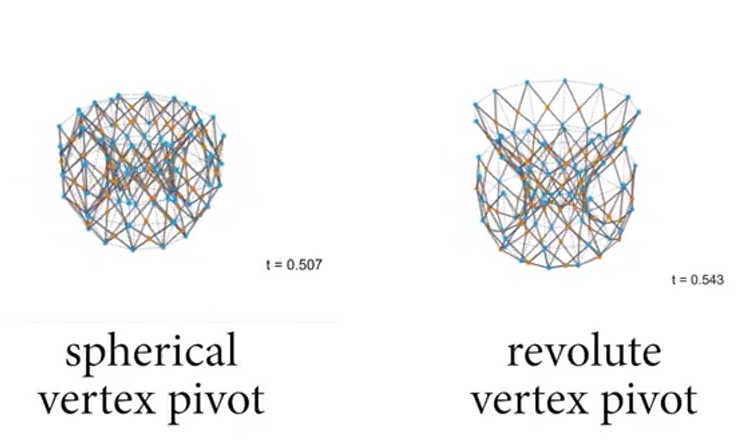
We introduce an additive approach for the design of a class of transformable structures based on two-bar linkages (“scissor mechanisms”) joined at vertices to form a two-dimensional mesh which we call a pantograph lattice. Our approach shows how these lattices unfold from a one-dimensional collapsed state to two-dimensional surfaces of single and double curvature. We provide an algorithm for growing pantograph structures that allows us to explore the full space of possible mechanisms, and we use it to computationally design and physically assemble a series of examples of varying complexity. We finally demonstrate a streamlined method for automated fabrication of pantograph lattices using multimaterial 3D printing.