

2026-06-04 スタンフォード大学
◆従来、居住可能惑星の探索は、恒星からの距離によって定義される「ハビタブルゾーン」を主な指標としていたが、実際には大気組成、地表環境、惑星形成史など多くの要因が生命維持能力に影響する。研究チームは、惑星科学や気候科学の知見を統合したモデルを構築し、多数の観測データとシミュレーションを組み合わせて、生命維持に適した惑星の特徴をより高精度に評価できるようにした。この手法により、膨大な候補天体の中から生命存在の可能性が高い惑星を優先的に選別でき、次世代宇宙望遠鏡による観測効率の向上が期待される。また、地球型惑星の進化や大気形成過程の理解にも貢献すると考えられている。
◆研究は、太陽系外惑星探査における新たな評価基盤を提供し、人類による地球外生命探索の加速につながる可能性を示した。
<関連情報>
- https://news.stanford.edu/stories/2026/06/model-search-life-supporting-planets
- https://iopscience.iop.org/article/10.3847/PSJ/ae6804
地球より小さい惑星の居住可能性モデル(STEHM):居住可能領域における大気保持の最小サイズ限界 Smaller Than Earth Habitability Model (STEHM): The Lower Size Limit for Atmosphere Retention in the Habitable Zone
Michelle L. Hill, Stephen R. Kane, Bradford J. Foley and Laura K. Schaefer
The Planetary Science Journal Published: 2026 June 4
DOI:10.3847/PSJ/ae6804
Abstract
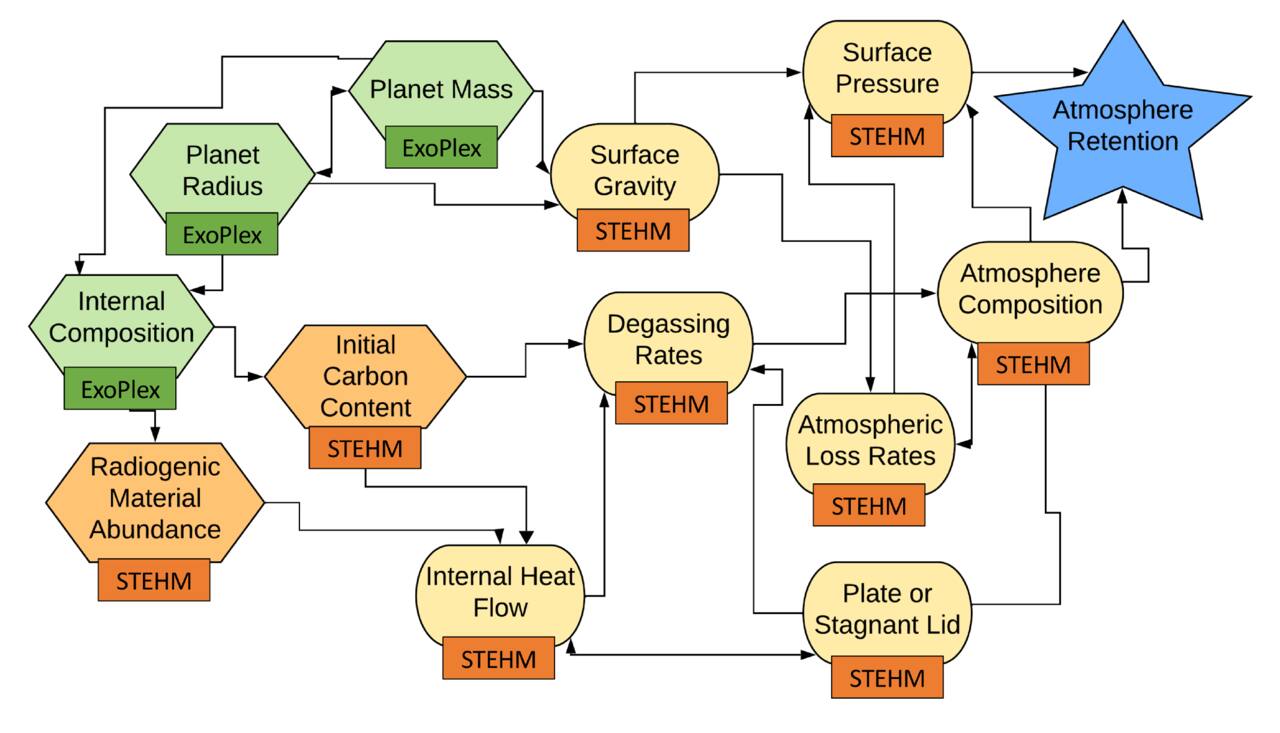
With recent advances in exoplanet observational techniques enabling the discovery of increasingly smaller planets, a crucial question emerges in the search for habitable planets: how small can a planet be and still maintain an atmosphere? We present results from the Smaller Than Earth Habitability Model, which examines how small a planet can be and still maintain a long-term (multi-gigayear) atmosphere for planets from 1.0 down to 0.5 R⊕. The model is based on a stagnant lid planet orbiting within the habitable zone of a Sun-like star. Our model demonstrates that planets ≥0.8 R⊕ can maintain their atmospheres under our Earth-like default conditions for a solar-analog star, while smaller planets lose their atmospheres. Variations from the default Earth-like values cause mostly minor variations to the planet size boundary results, with some changes allowing ≥0.7 R⊕ planets to maintain their atmosphere. Initial carbon inventory emerges as the most influential parameter for atmospheric retention, though orders-of-magnitude differences to Earth values are required to make a significant difference to longevity of atmospheric retention. Planets with substantial initial carbon content, large amounts of heat-producing elements, cool initial mantle temperatures, and low core radius fractions show the best atmospheric retention capabilities. Our results indicate that atmospheric retention on small planets depends strongly on their formation conditions and early evolution, providing important constraints for future observations of rocky exoplanets and their potential habitability.

