2026-06-23 中国科学院(CAS)
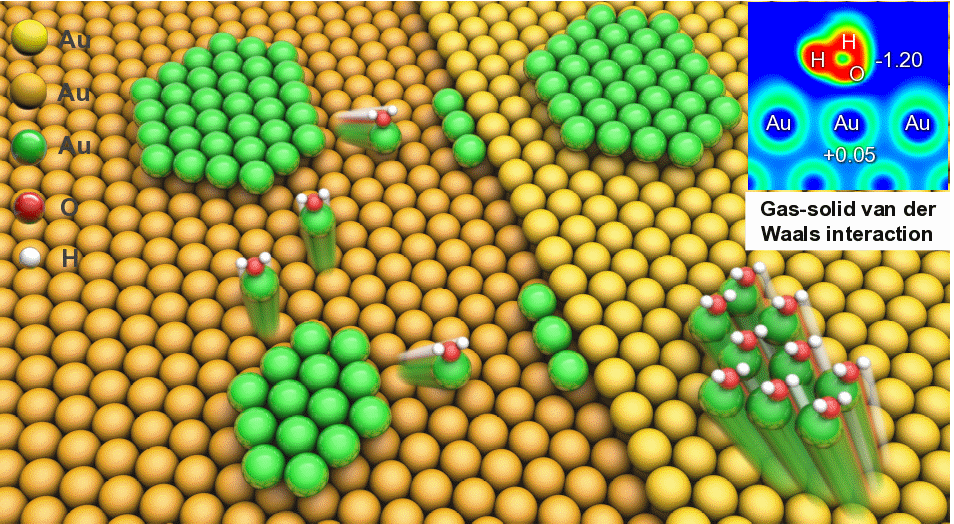
Schematic of van der Waals interactions drive the rapid migration, coalescence, and ripening of Au nanoislands on Au(111) in H2O atmosphere. (Image by LIU Changping)
<関連情報>
- https://english.cas.cn/newsroom/research-news/202606/t20260623_1174492.shtml
- https://pubs.acs.org/doi/10.1021/jacs.5c22700
気体と固体間のファンデルワールス相互作用が表面ナノ構造の動的な進化を促進する Gas–Solid van der Waals Interaction Driving the Dynamic Evolution of Surface Nanostructures
Changping Liu,Heng Liang,Jie Luo,Xi Cheng,Rentao Mu,Hao Li,Yifan Li,Yi Cui,Qi Wang,Xiang-Kui Gu,Wei-Xue Li,and Qiang Fu
Journal of the American Chemical Society Published: June 9, 2026
DOI:https://doi.org/10.1021/jacs.5c22700
Abstract
Weak intermolecular forces are ubiquitous in chemistry, materials science, and biology, yet their direct role in gas–solid interfacial phenomena has remained elusive. Here, we show that under millibar-range H2O vapor at room temperature, monolayer Au nanoislands on Au(111) undergo pronounced restructuring within seconds through particle migration, coalescence, and Ostwald ripening. The driving force of these rapid dynamics is identified as van der Waals interaction between H2O molecules and surface Au atoms via dipole–dipole attraction. This effect is reinforced by the formation of transient H2O-adsorbed Au adatom complexes, which lower the energy barrier for atomic detachment and migration. Our findings provide direct atomic-level evidence that weak physical interactions alone can reshape metal nanostructures, offering a new route to engineer the surface architectures under mild conditions.