2026-06-22 イリノイ大学アーバナ・シャンペーン校
<関連情報>
- https://aces.illinois.edu/news/illinois-study-explores-feasibility-creating-sustainable-jet-fuel-food-waste
- https://www.nature.com/articles/s41893-026-01848-1
- https://tiisys.com/blog/2025/11/03/post-178888/
食品廃棄物から持続可能な航空燃料を製造する循環型水熱精製装置 A circular hydrothermal refinery for sustainable aviation fuel from food waste
Buchun Si,Zixin Wang,Jamison Watson,Sabrina Summers,Yalin Li,Siying Yu,Hong Yang,Zhibin Yang,Joshua S. Heyne,Jinyue Jiang,Zhiyong Jason Ren,Hemin Ma,Chaoyuan Wang,Pengsen Wang & Yuanhui Zhang
Nature Sustainability Published:03 June 2026
DOI:https://doi.org/10.1038/s41893-026-01848-1
Abstract
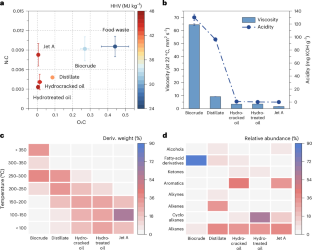
The aviation industry faces a formidable challenge in transitioning to carbon-neutral flight without compromising the rigorous performance standards of jet engines. While hydrothermal liquefaction (HTL) of wet waste offers a transformative pathway for sustainable aviation fuel (SAF) production, its potential remains hindered by biocrude quality and the environmental burden of the aqueous phase (HTL-AP). Here we present an integrated hydrothermal refinery that converts food waste into a high-performance SAF candidate through a closed-loop process of HTL, catalytic upgrading and HTL-AP valorization. Our refined fuel—composed predominantly of cycloalkanes (70.5 wt%)—exhibits a higher heating value and lower freezing point than conventional Jet A. Critically, unlike alcohol-to-jet or hydrotreating esters and fatty acids (HEFA) pathways, this HTL-derived SAF meets flash point and viscosity constraints as a 100% drop-in fuel without blending. We further address the ‘waste’ bottleneck by employing partial electrooxidation and electrodialysis to recover high-purity acetic acid (91.6% of organics) and nutrients (>76.9%) from the HTL-AP, while simultaneously generating sufficient hydrogen to sustain the biocrude hydrotreating stage. Techno-economic and life-cycle analyses reveal that while electricity costs currently influence the minimum fuel selling price, the integration of renewable energy and optimized electrochemical recovery can achieve market competitiveness (US$3.82 GGE−1) and a net-negative carbon footprint (−8.5 kg CO2e GGE−1). These findings establish a circular, carbon-negative framework for transforming urban organic waste into high-density aviation energy.