
2026-06-23 京都大学,名古屋大学,科学技術振興機構
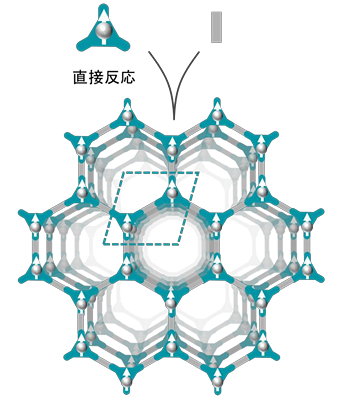
図1 RCOFの構造の概念図 緑色はラジカルを含むユニット、灰色はそれをつなぐリンカーを示す(R. Paitandhi 作成)
<関連情報>
- https://www.jst.go.jp/pr/announce/20260623-2/index.html
- https://www.jst.go.jp/pr/announce/20260623-2/pdf/20260623-2.pdf
- https://www.nature.com/articles/s41467-026-74618-4
磁気的および電気的特性を有する二次元ラジカル共有結合性有機骨格の直接構築 Direct Construction of Magnetic and Electrical Two-Dimensional Radical Covalent Organic Frameworks
Rajendra Prasad Paitandi,Madhurima Giri,Ryosuke Koyae,Masaki Nobuoka,Yusuke Tsutsui,Yoshiaki Shuku,Yun Hee Koo,HZhuowei Li,Yuta Sakurai,Katsuaki Suzuki,Javier López-Cabrelles,Shuhei Furukawa,Hironori Kaji,Masayuki Suda,Samrat Ghosh & Shu Seki
Nature Communications Published:23 June 2026
DOI:https://doi.org/10.1038/s41467-026-74618-4
Abstract
Radicals arranged in a two-dimensional (2D) hexagonal network can offer various exotic magnetic, electronic, and optical properties that find application in electronics/spintronics. However, direct synthesis remains challenging due to the scarcity of stable, symmetry-matched radical building blocks. Here, we report the bottom-up synthesis of hexagonal 2D radical covalent organic frameworks (RCOFs) with unpaired electrons at the nodes of the frameworks. A planar verdazyl radical amine (V-NH2) undergoes Schiff-base condensation with aldehydes to afford highly crystalline hexagonal RCOFs (VTPT and VPMT). The spin density was precisely controlled through the selection of building blocks with modulated spin-spin distances. The EPR and SQUID measurements confirmed a high spin concentration with antiferromagnetic interactions at low temperature, which is further tuned by interlayer interactions. Thin films of VTPT exhibited preferential in-plane orientation with enhanced photoconductivity, attributed to improved π-conjugation. These findings establish a direct route to RCOFs and underscore their potential as pseudo 1-dimensional antiferromagnetic materials.
